 Vantage
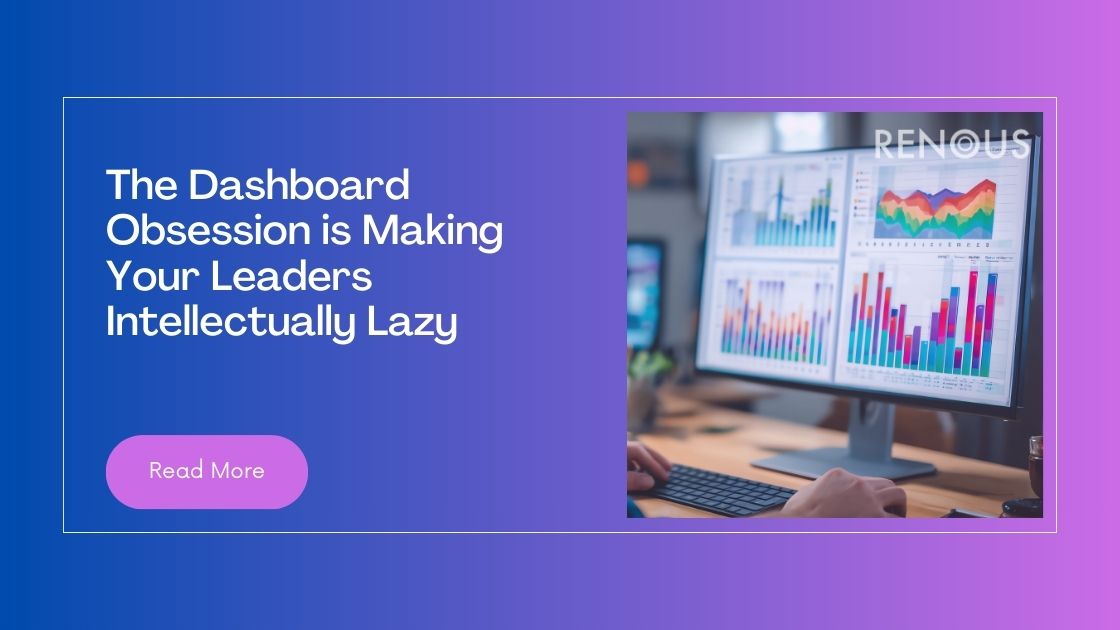
There is a moment that plays out in boardrooms every week. A senior leader opens a sleek analytics platform, scans a sea of charts and KPI tiles, and walks away feeling informed. They've seen the numbers. They believe they understand what is happening in their business.
They don't. What they have done is something far more dangerous than ignorance: they've mistaken the map for the territory. They have consumed data without exercising judgment and — most critically — outsourced the hard cognitive work of leadership to a piece of software.
The Cognitive Trap
Cognitive science has a term for what dashboards are doing to executive thinking: cognitive offloading — the process of delegating mental tasks to external tools. In moderation, this is perfectly rational. But heavy cognitive offloading carries a well-documented cost: the atrophy of the skills being offloaded.
Studies on GPS dependence show measurable declines in spatial reasoning among heavy users. The same logic applies to leadership. When executives consistently rely on dashboards to tell them what is happening — rather than building and testing mental models of their own — they stop developing the pattern recognition, contextual judgment, and predictive intuition that define genuinely exceptional leaders.
The dashboard tells you what. It rarely tells you why. And it almost never tells you what to do about it.
"The dashboard tells you what. It rarely tells you why. And it almost never tells you what to do about it."
Metrics Without Meaning
Every metric is a simplification — a compression of complex reality into a single number. That compression involves assumptions about what to measure, what to exclude, and how to weight different factors. Those assumptions bake in blind spots. And those blind spots can be catastrophic.
A company can sustain a high NPS for quarters while quietly losing its most valuable customers — because those customers are too busy to register dissatisfaction through formal channels. The metric looks fine. The business is eroding. The dashboard says nothing.
Leaders who are genuinely engaged with their businesses develop what might be called metric scepticism — a healthy suspicion of what any single number is actually telling them. Dashboard-dependent leaders rarely develop this skill. The number is green. That means it's fine. Next slide.
The Meeting Room Symptom
You can spot dashboard dependency in how meetings are run. If your leadership team spends most of its time reviewing dashboards together — narrating numbers back to each other — something has gone seriously wrong.
These meetings are full of descriptive statements masquerading as analysis. 'Revenue is up 4%.' 'Churn increased this quarter.' Everyone nods and updates their mental scorecard. What is almost entirely absent is genuine causal reasoning. Nobody asks: why did churn increase — and are we confident we know the real reason, as opposed to the convenient story we've told ourselves?
The dashboard has filled the meeting with content. The meeting has produced almost no original thinking.
"The dashboard has filled the meeting with content. The meeting has produced almost no original thinking."
What Good Looks Like
None of this is an argument against dashboards. Used properly, they remain powerful tools. The issue is the relationship leadership has developed with them.
The organisations that use data most effectively treat dashboards as a diagnostic starting point, not a conclusion. They invest in data literacy — not just the ability to read metrics, but to understand what those metrics do and do not measure. They protect time for unstructured, metrics-free thinking. And they build cultures where challenging a metric is valued rather than suppressed.
Some of the most strategically sophisticated leadership teams deliberately schedule sessions with no dashboards, no KPIs, no prepared slides — just the question: what is actually happening in this business, and what should we do about it? These sessions are uncomfortable precisely because they cannot be filled with data narration. They require actual thinking. That is the point.
The Leader's Responsibility
The most important things happening in any business are almost never fully visible in a dashboard. The cultural shift building momentum beneath the surface. The talent drain that hasn't yet appeared in attrition numbers. The customer relationship eroding in ways that satisfaction scores won't capture for another two years.
Dashboards are mirrors. They show you the recent past in the form your organisation chose to measure it. Leadership is about the future — and about reality in all its unmeasured complexity. The best leaders have always known this. The risk, in the age of beautiful, always-on analytics platforms, is that we forget it entirely.