 Vantage
By Varun Dhingra | Founder, Renous | The GCC Mandate
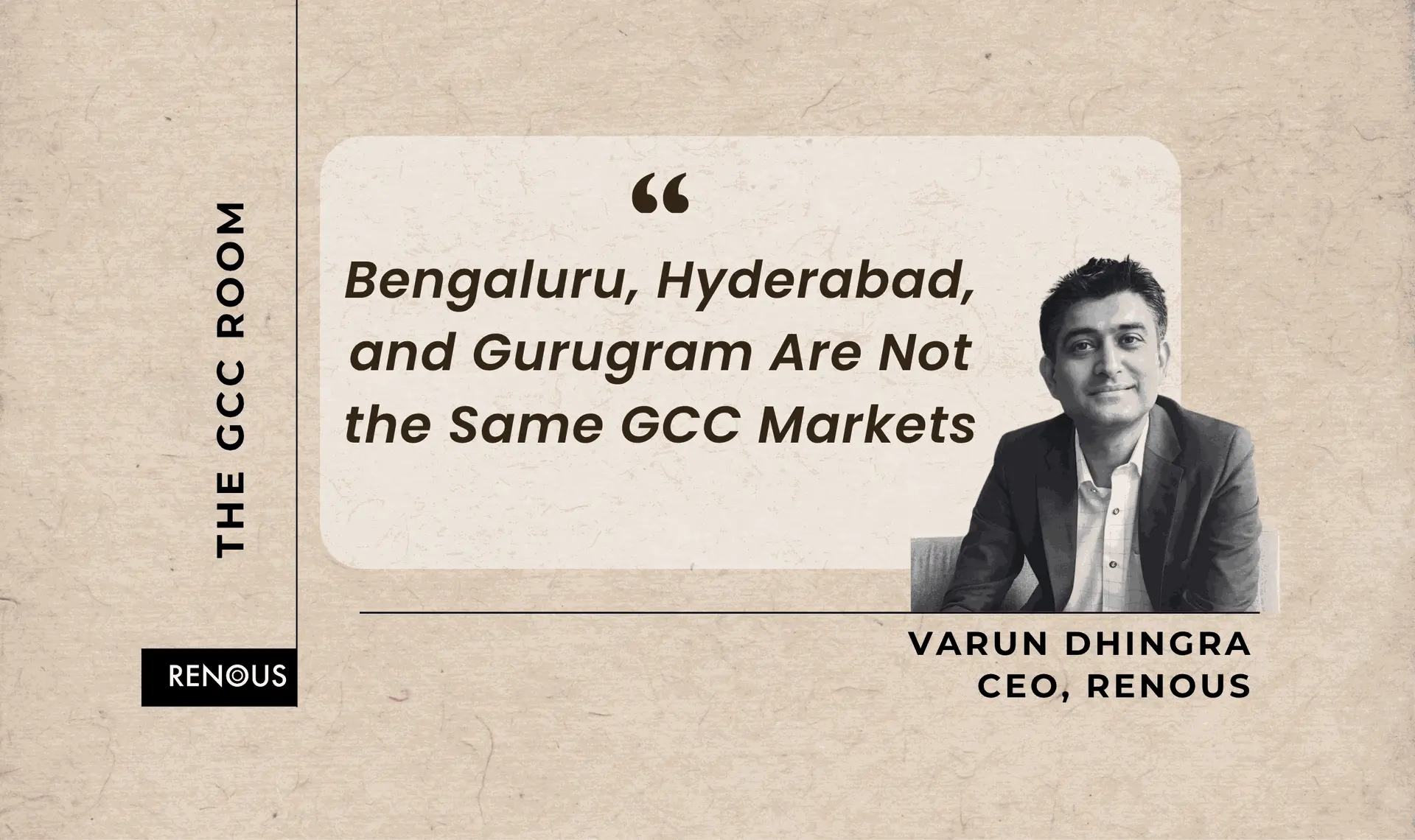
I have sat in GCC roundtables across Bengaluru, Hyderabad, and Gurugram for the better part of two years. Same format, same invitation list, same themes. And yet the conversations are never the same. The pressure points are different. The ambitions are different. Even the silences are in different places.
The data confirms what practitioners already know. India now hosts over 1,700 Global Capability Centres, with Bengaluru accounting for nearly 880 of them, Hyderabad sitting at 355, and Delhi NCR — led by Gurgaon — holding around 13% of the national footprint. But those numbers are the easy part. What they do not tell you is what it actually feels like to run a GCC in each of these cities, and why the playbook that works in one market can quietly fail in another.
"The playbook that works in Bengaluru can quietly fail in Gurgaon. Not because the leader is wrong. Because the city is different."
City 01:
Bengaluru — The Default
880+ GCC centres · ~35–40% of India's total · Deepest ER&D and AI talent base in the country
Bengaluru is where the GCC story began. Texas Instruments set up here in 1985 and the city has never stopped compounding. It is the first choice for deep tech, AI, and innovation-heavy mandates. Goldman Sachs, Walmart, Intel, Rolls-Royce — the roster reads like a who's-who of global enterprise. When a global CHRO or CTO says "we want to build something serious in India," their first instinct is still Bengaluru.
But that primacy comes with a cost that does not appear on the spreadsheet. Talent attrition in Bengaluru runs hot — not because people are disloyal, but because the market is so liquid. A strong engineer in Whitefield has four offers before lunch. The GCC leader who manages a Bengaluru centre spends a disproportionate amount of their time on retention architecture: comp bands, equity participation, learning budgets, hybrid policies. The mandate conversation gets crowded out by the talent conversation.
What I have noticed in our Bengaluru rooms is that GCC heads here are often the most technically sophisticated in the country, but they are also the most exhausted. They are managing scale, complexity, and a talent market that never sleeps.
The question they rarely have space to ask is: are we actually doing strategic work, or are we very expensively doing operational work at scale?
City 02
Hyderabad — The Most Interesting Room Right Now
355+ GCC centres · 70 new centres added in FY2025 alone · Backed by T-AIM and 940+ startups
If I had to pick one GCC market that is punching above its weight right now, it is Hyderabad. The city has moved fast — Vanguard, McDonald's, T-Mobile, Marriott, DAZN all chose Hyderabad in 2025. One of the world's largest investment firms, with over $10 trillion in AUM, described its Hyderabad setup explicitly as a talent-first play, not a cost play. That sentence alone tells you something has shifted.
The Telangana government's posture has been unusually active. T-AIM, land subsidies, employment-linked support — there is a policy infrastructure here that Bengaluru's scale does not require and Gurugram's fragmentation has not yet produced. For a GCC leader making a location decision, Hyderabad currently offers the best combination of talent depth, cost structure, and government tailwind.
What makes the Hyderabad conversation different in our rooms is aspiration.
These GCC leaders are building something that does not have a predecessor in their city. They are not inheriting legacy org structures or fighting decades of accumulated process debt. There is a hunger in the room that is harder to find in Bengaluru, where many GCCs are already mature and the leadership challenge is preservation, not construction.
City 03
Gurugram — The Market Nobody Has Figured Out Yet
Delhi NCR ~13.4% of India's GCC base · Multi-sector: BFSI, pharma, consulting, telecom
Gurugram is the most complex GCC market in India, and the least written about. It does not have Bengaluru's depth or Hyderabad's momentum narrative. What it has is diversity — BFSI, consulting, pharma, telecom, professional services. EY, KPMG, Deloitte all run significant operations here alongside more traditional tech GCCs. That mix creates a leadership culture that is genuinely different.
The Gurugram GCC leader tends to operate in closer proximity to Indian corporate headquarters — major conglomerates, large domestic enterprises, regulators. That proximity is an advantage and a constraint simultaneously. The stakeholder complexity is higher. The politics are more visible. A GCC head in Gurugram is navigating not just their global parent but an entire ecosystem of domestic relationships that simply do not exist in the same way in Hyderabad or even Bengaluru.
The talent market here is also structurally different.
Gurugram draws heavily from Delhi University, the IIMs, and a large professional services talent pool that thinks differently about careers than the engineering-first talent that dominates the south.
The GCC leader in Gurugram is often building a more cross-functional capability — not just engineering or product, but finance, legal, compliance, analytics.
That is a different leadership challenge entirely.
What this means if you are the one running the show
The practical implication of all of this is simple: your city is part of your mandate. Not a backdrop to it. The talent model you build, the retention levers you pull, the case you make to global leadership for expanding your charter — all of it is shaped by where you are sitting.
A Bengaluru GCC head who imports their Gurugram playbook will overinvest in stakeholder management and underinvest in talent retention. A Hyderabad GCC head who benchmarks against Bengaluru norms will either overpay for talent or build unrealistic attrition expectations into their three-year plan. A Gurugram GCC head who tries to compete with Bengaluru on pure tech depth will spend years building a team for a mandate that their local market does not naturally produce.
"Your city is part of your mandate. Not a backdrop to it."
The leaders I have seen navigate this well are the ones who stopped benchmarking their city against the others and started building to its actual strengths.
They made the city a feature of their pitch to global stakeholders, not a footnote.
They hired for the talent that their city produces abundantly, not the talent their HQ imagines should exist there.
The ones who struggle are usually trying to run the same playbook everywhere because it is what global leadership expects. That gap — between what HQ imagines India looks like and what each individual city actually is — is one of the most quietly costly misalignments in the GCC world. And almost nobody talks about it out loud.
Until now, perhaps.