 Vantage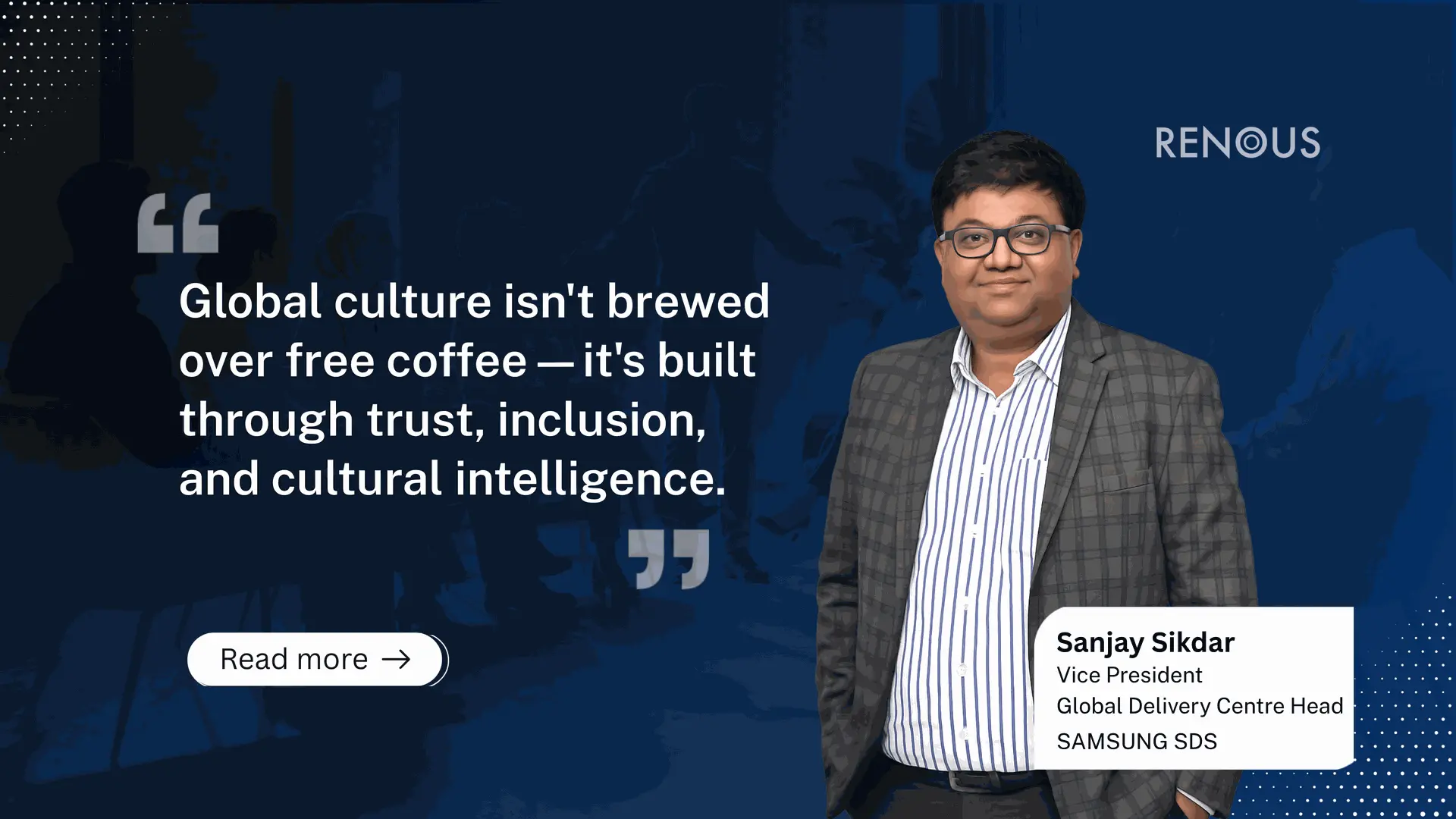
Though on the surface it looks a little humorous, there is a deep-rooted message here that holds true across borders.
As Peter Drucker famously put it, culture eats strategy for breakfast.
Any organization's growth rests on three pillars — capability, capacity, and continuity — and at its core, each one depends on organizational culture.
But at its core, each pillar depends on organizational culture.
ORGANIZATIONAL GROWTH
|
CAPABILITY to grow |
CAPACITY to grow |
CONTINUITY to grow |
ORGANIZATIONAL CULTURE - the foundation every pillar rests on
So the basic question is: what is culture?
In simple terms, culture is what people believe. It is not what is printed and pinned in your cubicle; it is the collective way an organization thinks, behaves, and makes decisions — and, most importantly, how it reaches people in the corridor.
Culture and Cohesion
How important is culture in building cohesion?
Cohesion in a team comes from:
• Trust
• Clear communication
• An environment where there is no fear of missing out
These are essential to seed cohesion in a team.
In some organizations, the traditional team event is replaced by more open sessions with leaders, where the focus is on hearing from employees rather than passing down the message, value drivers, or vision roadmap.
People might point to the following as “culture”:
• Quarterly team events / parties
• Annual celebrations
• Free coffee / cookies
• Flexible Fridays
- but these are initiatives, not culture.
Culture is not an employee benefit. Culture is the operating system a company runs on.
Going Global: Expansion vs. Evolution
When going global, we need to understand that it isn’t just about expansion — it is about evolution.
Going global isn't just expansion — it's evolution, and it rests on three non-negotiables: embracing culture, streamlining systems, and enabling local talent.
Understanding Cultural Dynamics
Additionally, we should keep cultural dynamics in mind while building a global team.
• Time zones reshape decisions.
• Communication norms and protocols differ. You might be direct in your approach in one market but be misunderstood as rude in another. In one country you can open a presentation with humor, but it might fall flat in another culture.
• Build trust based on culture. In some cases it is based on outcomes; in others, it is based on relationships. Prepare to design for both.
Cultural Tips to Avoid Conflict in Global Teams
For a global team, some proven cultural tips to avoid conflict are:
|
✔ Favor written communication |
|
✔ Document how decisions get made |
|
✔ Follow customs that travel across regions |
|
⚠ Don’t experiment on the first day. |
The Challenge of Integrating Culture Across Borders
Any global team or project is highly dependent on a large base of remote teams spread across the world — for example, India, the Philippines, Vietnam, China, and Romania.
Hiring across borders is easy, but integrating culture across borders is the real challenge.
So the culture pyramid for a remote team rests on the following points:
1. Inclusion — the team should never feel like it is missing out; build an inclusive culture.
2. Appreciation and visibility
3. Shared customs and rituals
4. Frequent physical touchpoints by leadership and stakeholders
5. Local support
6. AI-enabled culture — embrace and stay eager to adopt AI across job functions.
Cultural Agility: Thinking Beyond Borders
Another necessity in a multicultural global team is cultural agility — the ability to think beyond borders. For example, if something goes wrong:
• Take a pause.
• Do a self-introspection with positive intent.
• Try to understand what it meant in their culture.
In a global team, clarity is the ultimate thing — so speak clearly and listen carefully.
You also need to understand the CQ (Cultural Quotient) of your team while communicating. Is the team culture:
• More egalitarian — where you might challenge your leader, or
• Hierarchical — where people hesitate to disagree?
|
Egalitarian |
Hierarchical |
|
Team may openly challenge the leader. Flat networks · Open debate · Peer authority |
People may hesitate to disagree. Clear hierarchy · Deference · Top-down flow |
Know your team's CQ before you communicate.
So any presentation or training program curated for a global team should include examples from multiple cultural contexts. It will fall flat if every example reflects one style or one set of norms.
As a leader, you must think about:
• How the same situation can be interpreted differently across cultures
• How a manager might need to adapt when working across two culturally different regions
Culture in Action
In the end, culture is not what you say but what you do. Here is a short to-do list on culture:
1. Align goals through behavior. Successful global firms don’t wait for a behavioral manual; they empower teams to act autonomously during a crisis.
2. Use AI as a cultural accelerator. It flattens hierarchies through AI adoption and helps the organization shift focus from manual work to high-value strategy.
3. Before you scale inorganically, evaluate decision-making styles and don’t restrict AI-native teams in silos.
4. Drive cultural integration across generations. Most senior leaders (Gen X and Boomers) interpret the Gen Z approach to work through their own generational lens. What an older generation calls impatience, Gen Z might call a desire for rapid growth or transparency. In such cases, organizational culture should take precedence
Conclusion
In today’s world, an LLM can craft a flawless transformation model at the click of a button — but it cannot navigate organizational DNA, people dynamics, or corporate politics. Nor can it motivate a team to rally behind a common, shared goal.
I expect expertise to become commoditized, with the real shift moving towards cultural consolidation.
The core of organizational transformation isn’t code — it’s people connection.
Organizations will increasingly have to invest in improving CQ (Cultural Quotient, through change management) and in the areas where culture can play a pivotal role in navigating corporate people dynamics.
|
AI CAN
|
ONLY PEOPLE CAN
|
The core of transformation isn’t code — it’s people connection.
About Author
Sanjay Sikdar has got close to 30 years experience in IT consulting , Analytics , AI and GCC advisory. Currently he is working as Vice president SAMSUNG SDS and in this role he is working as Global delivery center head for SAMSUNG SDS India.
Prior to this he has worked for 20 +years in IBM and 5 years in PwC . Sanjay is a pass out of IIT Kharagpur (B.Tech in Electronics and Electrical Communication) and Completed leadership courses from Cornell.
He has worked extensively in SAP Analytics, SAP commerce, AI and IOT . In IBM he worked as Industry Solution lead in Chemical Petroleum and Industrial products clients . Sanjay greatly enjoys working with Cultural Diversity having worked and lived extensively in India , Europe, USA , Nordic , Malaysia and Hongkong - Developing the cultural empathy needed to lead Vibrant and Distributed Global team .
Find him on LinkedIn: Sanjay Sikdar
Disclaimer from Renous
The opinions expressed in this article are those of the guest author and do not necessarily reflect the views of our publication. The information provided in this article is for general informational purposes only and should not be considered as professional advice. The reader should always conduct their own research and due diligence before taking any action based on the information provided in this article.