 Vantage
Artificial Intelligence has moved from experimentation to a strategic business priority. A large majority of organizations now use AI in at least one business function, while 86% of employers expect AI and information-processing technologies to transform their businesses by 2030.
Yet adoption does not equal impact.
“The real opportunity lies in redesigning how work gets done.”
AI is becoming an operating layer across the enterprise, influencing decisions, hiring, collaboration, customer engagement, and innovation. The advantage is likely to come from embedding AI into everyday workflows, not treating it as another technology initiative.
At NLB Services, this thinking has shaped how we approach AI. We see AI as the intelligence layer connecting people, processes, and outcomes. We are applying that thinking across our own operations.
Rethinking recruitment with AI
Consider hiring.
Recruitment remains heavily dependent on manual search, screening, coordination, and fragmented talent pools. Meanwhile, demand for skills across AI, cybersecurity, cloud, data, and digital transformation continues to grow.
AI can help change this model by making talent engagement more continuous and data-driven, giving recruiters greater visibility into skilled talent, strengthening candidate engagement, and supporting better hiring decisions. We have applied similar thinking in our own hiring workflows.
We have seen the impact of applying this approach at scale. For a $5 billion global technology services enterprise, an AI-enabled recruitment solution helped achieve a 15-day recruitment cycle and a 250-hire monthly run rate within four months. Data-rich dashboards gave teams greater visibility into performance and helped them identify and resolve issues quickly.
In security-cleared recruitment, AI-driven matching and workflow automation can support hiring speed, precision, compliance, and candidate experience.
Access to organizational knowledge
Then there is the information problem.
73% of companies use AI. Only a small share say it’s core to how they operate.
At NLB Services, we have found that an enterprise AI assistant can help employees access organizational knowledge, automate routine work, and make informed decisions with less friction.
From execution to intelligence
“AI is moving work from execution to intelligence.”
These examples point to a larger shift.
AI is moving work from execution to intelligence.
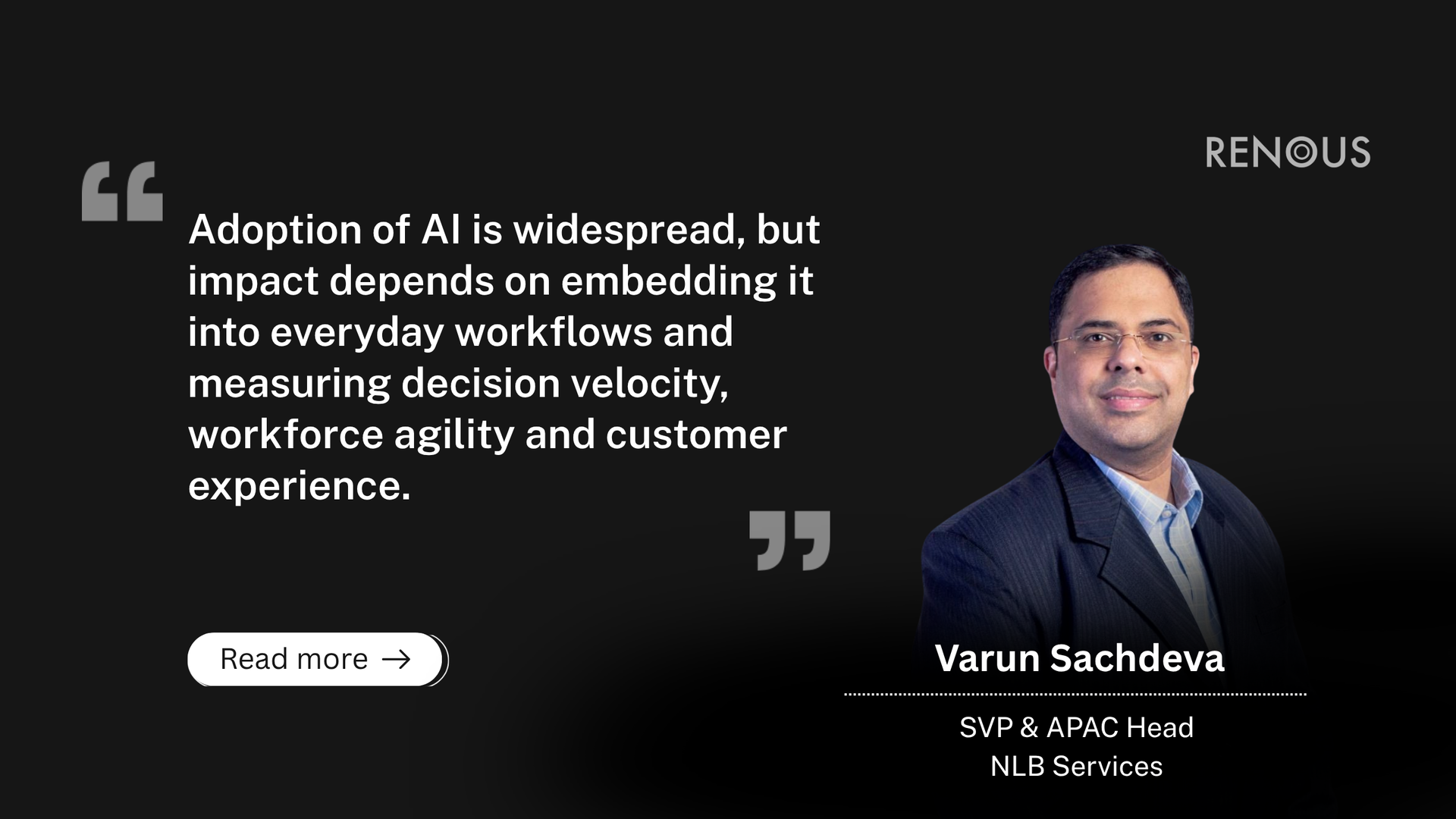
For years, enterprises measured efficiency through transactions completed, processes shortened, and costs reduced. The next set of metrics is likely to include decision velocity, workforce agility, customer experience, innovation, and speed to market.
The numbers from our own operations show what that shift can look like. In one technical support operation managing 25,000+ tickets annually, AI enabled 60%+ of tickets to be resolved autonomously. SLA adherence rose from 65% to 95% within six months, while CSAT increased from below 60% to 88%. These outcomes show how embedding AI into workflows can improve both operational performance and customer experience.
Shifting leadership priorities
That requires AI to sit within the workflow, supported by reliable data, responsible governance, secure platforms, and an AI-ready workforce.
Leadership priorities need to shift accordingly. The bigger question is where AI can make a meaningful difference to decisions, processes, and the people doing the work.
At NLB Services, this approach shows up across different business needs, each a practical business challenge where better information can change the way teams operate.
“That is the shift worth paying attention to.”
That is the shift worth paying attention to.