 Vantage

Prototypes That Look Effortless, Then Stall
Over the last sixteen years, my work has taken me from verifying inventory on factory floors during statutory audits, to implementing complex consolidation systems for global enterprises, to building a cloud financial reporting product from the ground up. Across every phase of that journey, one rule has held steady: in enterprise finance, speed means nothing if the foundation cannot bear weight. Today, AI-assisted workflows have dramatically shortened the distance between an idea and a working screen. What once took weeks of specification writing and wireframing now takes days, creating an exhilarating sense of momentum across product teams.
Yet when you sit across enterprise finance leaders during real discovery, a quiet paradox emerges. We are demonstrating capabilities that look effortless in a sandbox: autonomous close agents that match intercompany balances, language models that read thirty-page contracts to draft revenue schedules, and narrative engines that turn a trial balance into board commentary in seconds. On a clean dataset, these prototypes feel like a five-day close compressed into five minutes. Still, when evaluated for actual enterprise release, most of them stall long before they ever reach a customer’s live environment.
Production Readiness Is a Different Discipline
The mistake we often make as builders is assuming this hesitation comes from a fear of new technology. In my experience, finance leaders are rarely resistant to change; they are simply allergic to ambiguity. Current advancements in AI have brilliantly solved the time to build, allowing us to assemble interfaces and workflows at record speed. What they have not simplified is the logic of production readiness, which is an entirely different discipline.
A prototype only proves that a workflow can be assembled; it does not prove that a customer can stake a statutory filing on it.
Over the years, I have learned that technical feasibility is no longer the primary hurdle in enterprise software; business justification and genuine speed to value are. When you ship a feature that solves a secondary annoyance while introducing operational uncertainty, you do not save the customer time; you merely shift their effort from doing the work to auditing the machine.
In product management, especially when scaling a platform from zero to one and beyond, clarity on the priority-zero objective is everything. For a financial consolidation product, that P0 objective is uncompromising: closing the books reliably, repeatedly, and with an unbroken audit trail. Until a capability directly strengthens that core outcome without creating downstream doubt, even the most refined prototype will struggle to earn its place in general availability.
Deterministic Accounting Meets Probabilistic AI
This is where modern AI runs into a quiet structural tension with the nature of accounting itself.
Double-entry bookkeeping survives because it is strictly deterministic: debits equal credits; rules apply consistently, and running the same consolidation on a Tuesday morning and a Friday midnight yields the exact same figure to the fourth decimal place.
Most contemporary language models, however, are probabilistic by design, operating on patterns, proximity, and likelihood rather than fixed laws.
When a probabilistic engine is placed directly inside a deterministic close workflow, it introduces non-reproducible judgment where absolute certainty is required. In many software categories, getting something right about ninety-six percent of the time is a triumph worth celebrating at launch. In financial reporting, an unexplained four percent variance in an elimination entry is not a minor bug; it is a material weakness that stops adoption in its tracks.
Speed to Value, Not Speed to Prototype
Co-creating products alongside customer design partners teaches you very quickly where the real boundary lies. Enterprise buyers cannot defend a black-box probability score during a statutory audit, nor will they deploy software whose reasoning cannot be reconstructed six months later. If a finance team has to spend hours manually verifying what an agent drafted, the promise of speed evaporates, and the feature loses its business case.
Sixteen years in this space has taught me to respect why financial systems move with deliberate care. AI has permanently changed how fast we can explore ideas, test workflows, and bring concepts to the table with customers.
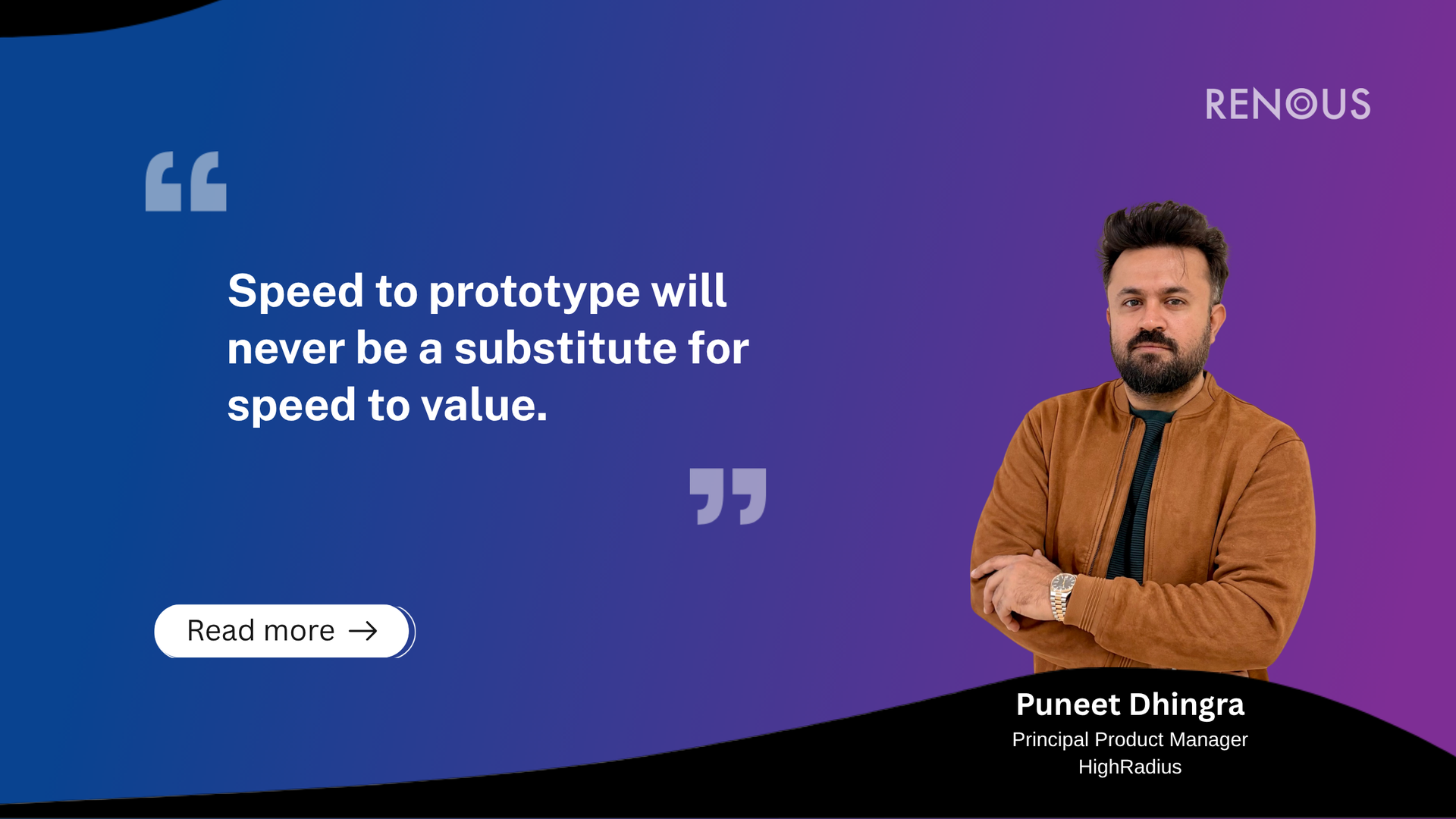
Still, speed to prototype will never be a substitute for speed to value, and I expect the features that truly endure will be the ones where intelligent acceleration respects the quiet discipline of a deterministic core.