 Vantage

Most senior careers reach a point where the things that made you successful begin to matter less than the things you never had to develop.
For years, your reputation rests on expertise. You know the business, you know your function, and you have the results to prove it. Then the role changes, and so do the questions people are quietly asking about you.
A CFO is no longer valued simply for understanding the numbers. The CEO needs someone who can help make hard choices about where the business goes next. A CHRO must think beyond talent processes to organizational capability and culture. A COO must see past efficiency. A CIO must tie every technology investment to a business outcome.
Expertise still matters. It just isn't enough anymore.
That is why I think executive presence deserves a second look.
The familiar model, popularized by economist Sylvia Ann Hewlett, rests on gravitas, communication and appearance. All three count. But they don't explain a pattern most of us have seen: the leader who is neither the most articulate nor the most charismatic person in the room, and yet is the one whose view settles the outcome.
My argument is that executive presence is less about how impressive you appear and more about what people experience when they deal with you, especially when the stakes are high. That experience starts long before you speak and carries on well after you leave.
When expertise becomes the limit
Most successful leaders get to where they are by becoming very good at something. Over time that expertise becomes their professional identity, which is natural. The trouble starts when the approach stays the same while the role around it changes.
I find it useful to think of four altitudes of leadership thinking. This is in line with a long tradition of research on leadership transitions, including the leadership pipeline work of Ram Charan, Stephen Drotter and James Noel.
- Domain: How does this work?
- Functional: How do we deliver it well?
- Business: What value does this create?
- Enterprise: What does this mean for the organization, its future and its ability to compete?
The distance between these levels is wider than it looks.
A finance leader can explain why costs have risen; an enterprise leader helps the organization see the choices those costs now force. A people leader can spot a talent shortage; an enterprise leader connects it to whether the strategy can be executed at all. An operations leader can explain a dip in productivity, while an enterprise leader is already weighing what it means for customers, margins, capacity and growth.
None of these means leaving your expertise behind. It means knowing when to use it, when to simplify it and when to step beyond it.
One of the hardest shifts in a senior career is moving from being the person with the answers to being the person who helps the organization ask better questions.
I have lived a version of this shift myself. I moved from an established leadership role to a consulting role on contract with a US-based firm (working from India). When this firm opened up their office in India, I was offered the chance to become their Head of HR.
The questions changed overnight. It was no longer about what I could do, but about what I could get done through others. It was no longer part of a function, but owning the whole of it. I felt I had something to prove to others and honestly to myself. So, I earned an industry-recognized certification and put my energy into building a team that delivered consistently.
I still remember my first leadership review as the Head of HR. I had to ensure I understood the business and the finances as much as the people.
The ceiling of competence
Some leaders are excellent at what they do. They build strong teams, run complex operations and deliver reliably. People trust them. And at some point, their careers simply stop moving.
Their performance hasn't slipped. Often, it is better than ever. What has changed is the expectation, and their way of leading hasn't shifted enough to meet it.
The person valued for operational answers is now expected to shape strategy. The person who managed people brilliantly now must influence a board or push back on a CEO. The person known for getting things done now has to show judgement about what is worth doing at all.
Then there are the smaller signals. Talking when the room needed listening. Answering before someone has finished. Misjudging how formal a conversation is. Being so locked on the agenda that you miss what is happening around it.
On their own, none of these matters much. Repeated, they become the evidence people use when deciding whether you are ready for more.
Enterprise leadership asks for a wider view, a sharper sense of context, and the ability to hold your own in conversations where you are not an expert. It means knowing when to speak, when to listen, when to challenge and when to stay quiet and watch.
Not every room needs the same version of you.
I once knew of a leader whose delivery record nobody would question. They grew up through the ranks of the same organization, leading much of the same team/business function for years, and were the person everyone called when something simply had to get done.
Then the business began to change. The conversation moved from how to deliver to what to deliver, and why. What was needed now was an outside-in view of the business, a willingness to challenge a team that had grown comfortable together, and a clear point of view on where things should go next.
The feedback came, more than once and from more than one direction. It didn’t land. The stakeholders around this leader quietly concluded that the leader had peaked, and the conversation turned to next steps.
The room had already read the situation. The leader hadn’t yet read the room.
The room is reading you
People rarely experience us the way we intend.
You think you are being thorough; others think you can't get to the point. You think you are projecting confidence; others decide you don't listen. You hold back an opinion out of humility, and your colleagues read it as a lack of conviction.
I call this the signal gap. Three things happen in almost every interaction:
- Intent: what you mean to communicate.
- Signal: what you actually send, through your words, decisions and behaviors.
- Experience: what the other person walks away with.
When the three line up, people say you have presence.
When they don't, the other person fills the gap with their own interpretation, and theirs is the one that sticks.
A leader can walk into a meeting determined to be open and collaborative, then spend most of it talking, interrupting and defending a position. The intent was collaboration. The experience was the opposite.
Perception isn't always fair. Hierarchy, culture, gender, familiarity and unconscious bias all shape it, and nobody should be coached into a narrow stereotype of what an executive looks or sounds like. Being aware of your signals is a different thing from conforming. One is self-knowledge. The other is a costume.
Not a long time ago, I was at the receiving end of the same feedback again and again. Speak up more. Push the team further. Widen your network. I couldn’t see why. Delivery was strong, the team was growing steadily, and people seemed to value my views. From where I stood, my intent and my results were both clear.
What changed my thinking was an outside, neutral perspective. An executive coach helped me look at my leadership from angles I hadn’t considered, starting with how it was actually being experienced by the people around me.
Speaking up more didn’t mean giving up the listening or empathy people valued in me. Pushing the team and widening the network didn’t mean becoming aggressive or turning into an extrovert overnight. It meant reading what each situation needed and having the range to respond to it.
I had been in a blind spot. I wasn’t reading the room, and it took someone outside it to show me what the room had been seeing all along. This is also why I have real empathy for leaders in the same place, including the one I described above.
It starts before you enter the room
Before an important meeting with the CEO, the board or a key client, most of us prepare the subject. We check the numbers, polish the slides and rehearse answers to the hard questions.
Far fewer of us prepare for the people.
Who will be there? What are they accountable for? What is worrying them right now? What happened the last time this came up? What do they already know, and what decision are they hoping to make?
The CEO may be listening to strategic implications. The CFO wants economics and risks. A business head is thinking about customers, and the CHRO about the effect on people and the organization. Same topic, four different conversations.
Good communicators ask what they want to say. The best also ask what this audience needs to understand, and what they need the audience to do.
Then there are the details we tend to wave away. How you walk in. Whether you have dressed for the occasion. Where you sit. Whether you make eye contact or disappear behind a laptop. Whether your phone stays face down. How you behave over coffee or lunch.
There is no executive uniform, and sitting at the head of the table has never made anyone a better leader. The point is simply that people form impressions across dozens of small moments, and the formal presentation is only one of them.
Speaking versus being heard
Experienced professionals often try to establish credibility by showing everything they know: more context, more data, more caveats.
Senior conversations usually need the reverse. Work out what matters, take a position and make the implications obvious.
Take two ways of presenting the same recommendation. The first walks through the background, the options, the dependencies, implementation and risks, and reaches the recommendation at the end. The second opens with the recommendation, explains why, names the main risk and states the decision needed.
The analysis behind both is identical. Only the second makes it easy for the room to decide.
Researchers increasingly study leadership communication as something leaders do, not something they perform. A 2023 review in The Leadership Quarterly by Evita Liu, Cassandra Chambers and Celia Moore brought together 260 studies that analyzed leaders' real words, in text, audio and video, rather than relying on how others described them afterwards. For practicing leaders, the takeaway is uncomfortable and useful: what you actually say, and how you say it, is observable, and it has consequences.
As you move up, the ability to simplify complexity without losing substance becomes one of the clearest markers of seniority. The skill is editing: knowing what needs to be said, to whom, and when.
Presence under pressure
The most revealing test of presence comes when things stop going your way.
Someone disagrees with you or questions your judgement. The numbers don't support your case. You must deliver an unpopular decision. Or you simply don't know.
Confidence is easy when you have the answers and the room is with you. What people remember is how you behave when that confidence is tested. Do you get defensive, interrupt, over-explain or look for someone to blame? Or can you listen, accept a fair challenge and respond without losing your footing?
Uncertainty needs particular care, because there is a trap in it.
In a series of experiments published in the Quarterly Journal of Experimental Psychology, Erik Løhre and Karl Halvor Teigen looked at how people judge leaders who admit uncertainty. Asked directly, participants said leaders should be open about it rather than project false confidence. Yet when they actually rated leaders, they saw them as less competent when the uncertainty was framed as personal ("I am not sure") than when it was framed as part of the situation ("this is uncertain").
In other words, we say we want honesty, then quietly mark down the most honest-sounding version of it.
The answer is not to hide what you don't know but to locate the uncertainty accurately. Very often it genuinely sits in the data, the market or the situation rather than in your competence, and saying so is both truthful and steadying:
"The data isn't conclusive yet. Here is what we know, here is what we are still testing, and I will come back with a recommendation by Thursday."
That shows judgement at work rather than a hole in it. Where the gap really is yours, say so plainly and say how you will close it. Nobody expects senior leaders to know everything. They do expect them to think clearly when they don't.
What executive presence really is
I don't believe it is a personality trait some people are lucky enough to be born with. Nor is it about being the loudest, the most polished or the most charismatic person in the room.
It is a set of connected capabilities that build over time:
- Seeing beyond your function to the enterprise.
- Preparing for the people, not just the subject.
- Holding a clear point of view.
- Noticing the signals your behavior sends.
- Staying composed when challenged.
- And underneath all of it, consistency between what you say and what you do, which is what turns a good impression into trust.
These aren't tricks for the boardroom. They are how you lead everywhere else, made visible when the stakes rise. And like most leadership capabilities, they can be learned.
A question worth asking yourself
Think about the last three important rooms you were in. A board discussion, a hard conversation with a peer, a client meeting, a session with your own team.
- Did you show how much you knew, or help others see what mattered?
- Did you prepare your presentation, or prepare for the people?
- Did you listen to understand, or wait for your turn?
- Did you make the decision easier for anyone?
- And when you were challenged, what did people see?
None of these are comfortable questions. They are useful ones.
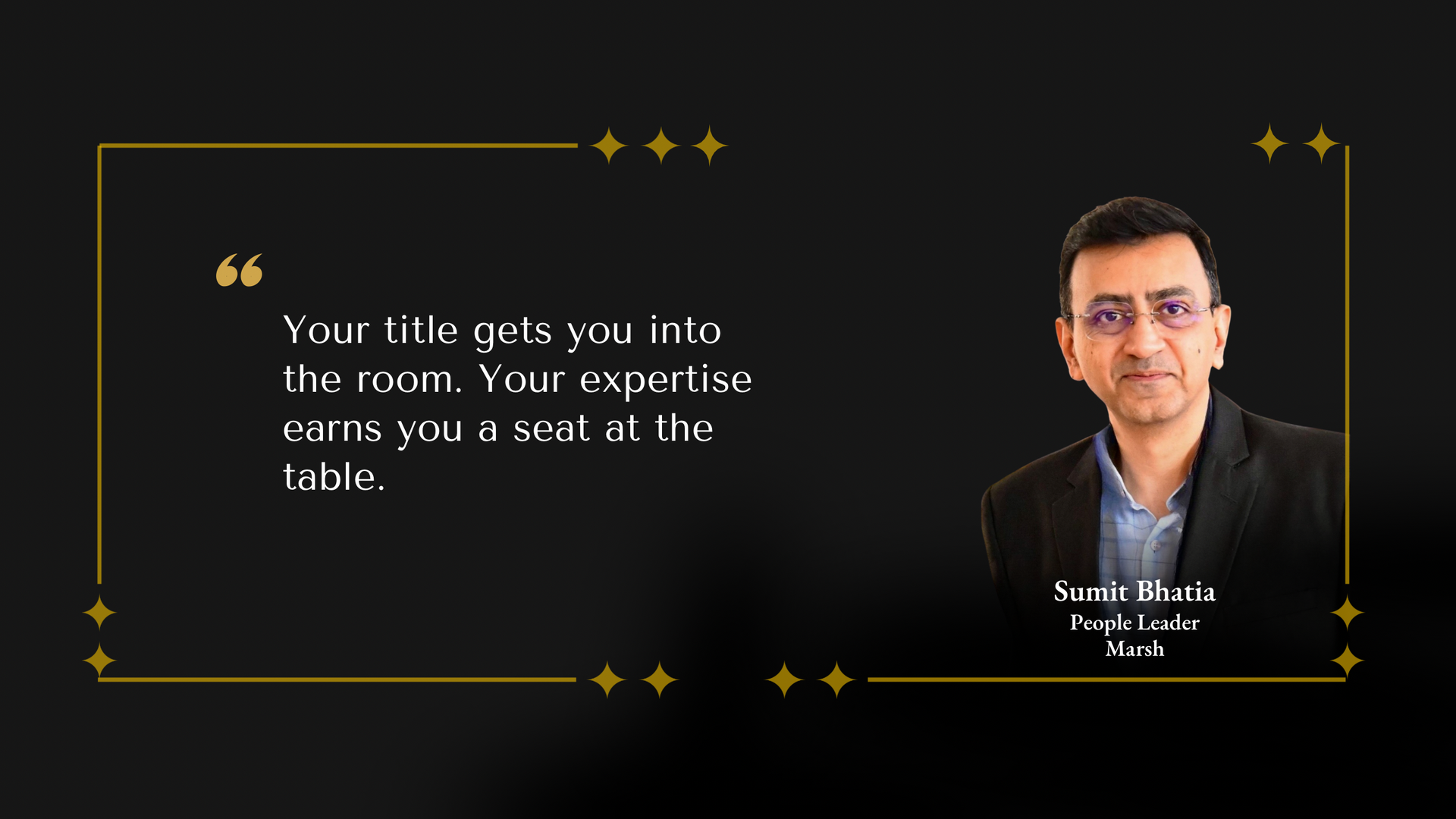
Your title gets you into the room. Your expertise earns you a seat at the table. Neither guarantees the influence you think you have. That comes from what people experience when you are there.
So, the better question may not be whether you have executive presence, but what your presence leads people to believe about your leadership