 Vantage

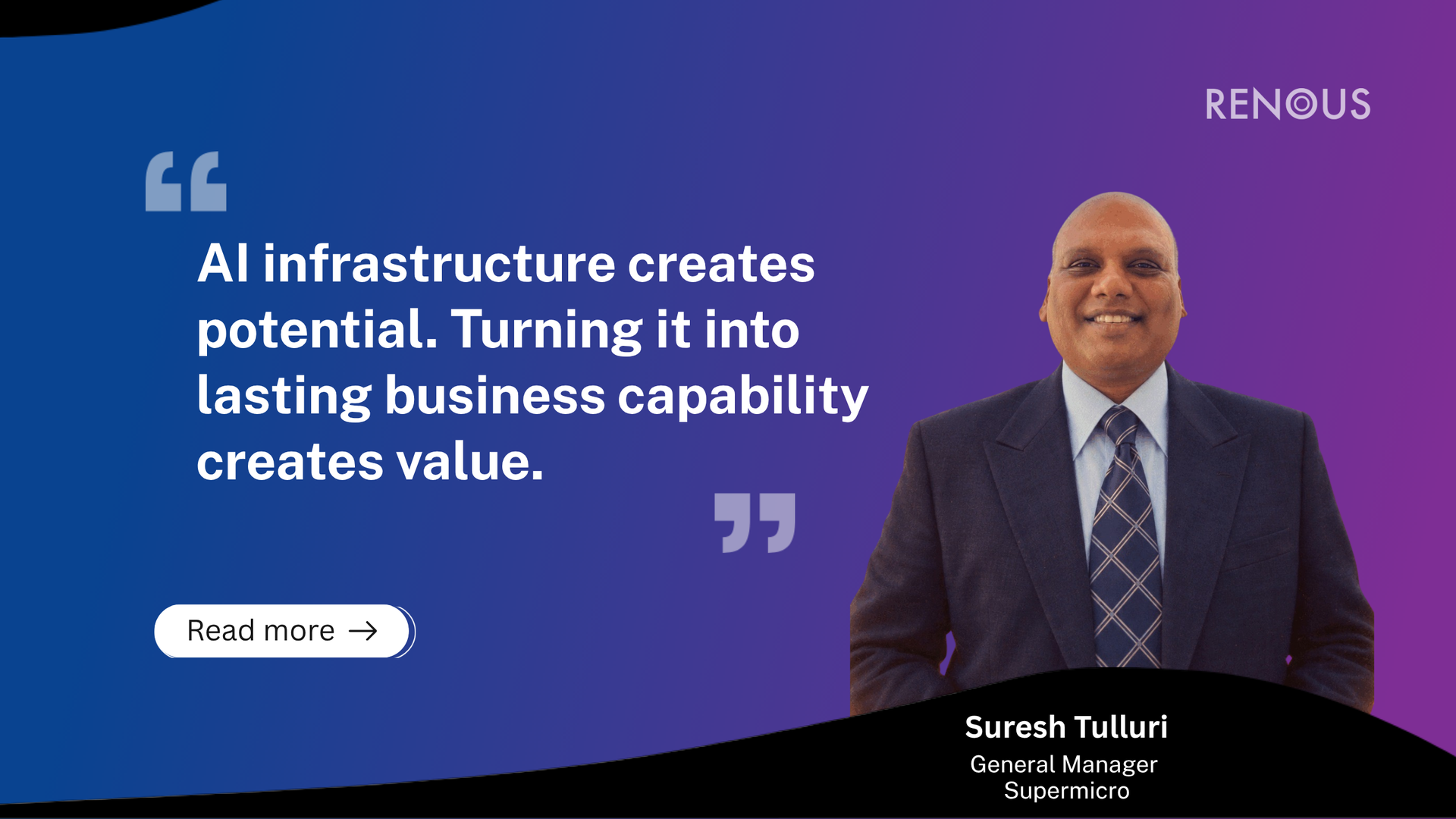
Installed technology is not lasting value
A company can acquire advanced AI infrastructure and still struggle to become an AI-enabled business. A country can expand its data centre footprint while leaving much of its potential for innovation unrealized.
The distance between installing technology and creating lasting value deserves far more attention in the AI conversation.
From the perspective of an AI infrastructure leader, I believe the defining management challenge is making compute productive: connecting infrastructure with data, people, processes and demand so that each investment strengthens the organization's ability to deliver.
“I call the resulting advantage the AI capacity dividend: the sustained value an institution earns when its AI investments become capabilities that people can use, trust and improve.”
That dividend is neither automatic nor purely technological. Leadership must create the conditions for it.
A demonstration is not yet a service
Consider a manufacturer deploying an AI assistant for maintenance engineers. An impressive demonstration may show that the system can retrieve technical documents and suggest a repair. A useful production service has a much larger obligation. It must identify the correct equipment, work with current documentation, respect access permissions, respond within an acceptable time and recognize when an engineer must take over.
Its economics must also make sense. If every response requires expensive computation, extensive checking or repeated correction, apparent productivity gains can disappear.
This example reveals why AI strategy needs a wider frame. Model capability, infrastructure performance and operational design determine the result together.
“The executive question therefore becomes: what must the organization be able to do reliably, and what combination of technology and operating discipline will make that possible?”
That question changes how infrastructure decisions are made.
Infrastructure readiness is a business issue
An AI deployment is a connected system. Accelerators depend on memory, networking and storage. The rack depends on power and cooling. Applications depend on data availability, software integration and operational support. Users depend on consistent performance.
A weakness in any part of that system can prevent the rest from delivering its intended value.
For leadership teams, this makes infrastructure readiness a business issue. Facilities planning, procurement, application development and commercial commitments need a shared delivery plan. Otherwise, an organization can find itself paying for equipment it cannot fully use, or promising services its environment cannot yet support.
The implications extend to the way capacity is purchased. Buying ahead of demand may be justified where access is constrained or deployment takes time. It still requires a credible path from installed capacity to productive workloads. Phased investment, clear readiness gates and explicit workload ownership can help align ambition with execution.
Measuring the cost of accepted outcomes
The most useful financial measure is consequently broader than acquisition cost.
“Leaders should ask what it costs to deliver an accepted outcome: a resolved service request, an engineering analysis that passes review, or a document processed to the required quality standard.”
That cost includes computation, software, integration, support and human oversight. It also includes the expense of failed attempts and rework.
A cheaper system can become expensive if it requires frequent correction. A more capable system can justify its cost if it consistently improves the outcome. Comparing the two requires a common definition of success.
This is where the CFO, CIO and business leader need to work together. Finance should understand the unit economics. Technology teams should understand the service requirements. Business owners should define the value and remain accountable for whether it appears.
Building foundations that teams can reuse
The capacity dividend also depends on how much an organization can reuse.
If every AI initiative creates its own data connections, security controls, evaluation process and support model, scaling becomes slow and costly. Each successful pilot starts another integration project.
Shared foundations change that equation. Governed access to data, reusable deployment services, common evaluation methods and clear operational standards allow new applications to build on earlier work.
For a global capability centre, this creates an opportunity to contribute beyond individual use cases. A centre can build capabilities that multiple business units adopt, support and extend. Its strategic contribution then includes shortening the path from a business problem to a dependable production service.
Reuse must remain practical. A shared platform earns adoption by helping teams deliver better results. Excessive centralization can create queues and distance platform decisions from the people using them. Leaders need common foundations alongside sufficient freedom for business-specific experimentation.
People turn tools into capability
People are equally central to this operating model.
Access to an AI tool does not, by itself, change how work gets done. Employees need to understand when to use it, how to assess its output and where responsibility remains with them. Managers need to redesign workflows so that time saved translates into better service, greater throughput or more thoughtful decisions.
A useful test is to ask what happens after the AI produces its answer. Who checks it? Who acts on it? What happens when it is wrong? How does that experience improve the service?
“If these questions have no clear answers, the organization has introduced a tool without establishing a capability.”
Leadership should also make room for employees to identify weaknesses. People closest to a workflow often know which exceptions will defeat a polished demonstration. Their involvement improves both adoption and system design.
The same logic at national level
At the national level, the same logic connects AI infrastructure with competitiveness.
For India, the strategic opportunity is to build the ability to deploy, operate and apply AI across a wide range of industries. Compute capacity becomes more valuable when it supports local enterprises, research institutions, developers and public-service needs.
That requires attention to access as well as scale. Smaller organizations need workable routes to infrastructure, relevant expertise and deployment support. Industry needs people who understand both AI systems and the domains in which they will operate. Infrastructure providers need an ecosystem capable of installation, maintenance and dependable service delivery.
Sovereign capability also deserves a precise definition. It includes meaningful control over sensitive data, operational continuity, system access and the ability to adapt. Different workloads will require different arrangements. The leadership task is to make those choices deliberately and understand the dependencies they create.
Questions that measure real progress
Across enterprises and national programmes, progress should be assessed through a small set of substantive questions. How quickly can a validated application reach production? What does a successful outcome cost? How reliably does the service perform? How much of the underlying capability can the next team reuse?
These questions encourage investment that compounds.
They also clarify what AI leadership demands. Leaders must connect decisions that are often separated across budgets and reporting lines: infrastructure with demand, experimentation with operations, workforce development with process redesign, and technical performance with economic value.
The organizations that do this well will gain more than a collection of AI applications. They will develop the ability to turn new technological possibilities into useful services repeatedly.
“That is the AI capacity dividend—and earning it is a leadership responsibility.”