 Vantage

An AI system processed a request, extracted information, and moved it to the next stage of a business workflow. Everything appeared to be working as expected until someone noticed that a name had been captured incorrectly. The mistake was small and easily corrected, but it revealed something much larger. The moment AI reaches production; the conversation changes from technology to accountability. Leaders stop asking how impressive the model is and start asking whether it can be trusted, governed, and scaled.
Over the past few years, organizations have moved rapidly from AI experimentation into real-world deployment. What happens after deployment is often very different from what happens during pilots and demonstrations. In my experience, the biggest barriers to AI success are rarely technical. They are organizational. AI creates value only when employees trust it, leaders sponsor it, processes adapt to it, and customers are willing to rely on it.
Here are seven lessons that stand out from taking enterprise AI from concept to production.
1. Start with the Business Problem, Not the AI
The objective should never be to deploy AI. The objective should be to solve a business problem.
This distinction sounds obvious, yet many organizations still begin by exploring the latest models and then searching for places to apply them. The most successful initiatives usually work the other way around. They begin with a clearly defined challenge, whether that is improving customer experience, reducing operational friction, increasing productivity, improving quality, or accelerating decision-making.
When the problem is clearly understood, every subsequent choice becomes easier. Teams can evaluate technology, costs, risks, and timelines against a tangible business outcome rather than technical novelty. AI creates value only when it solves something that matters.
Through my Lense:
Technology is the means. Value is the destination.
2. Data Quality Becomes a Trust Problem
Data quality is often discussed as a technical issue. In production environments, it quickly becomes a user issue.
Small imperfections that appear harmless during development can become significant when people rely on the output every day. Information may be incomplete, terminology may be interpreted inconsistently, or outputs may be technically correct but difficult to understand. While engineers might separate data quality issues from model quality issues, users rarely do.
To them, the output is the product.
Organizations that consistently improve AI outcomes usually discover that success requires improving the entire information flow. It is not enough to tune models. Information must be captured accurately, structured appropriately, validated consistently, and presented in a way that people can understand and trust.
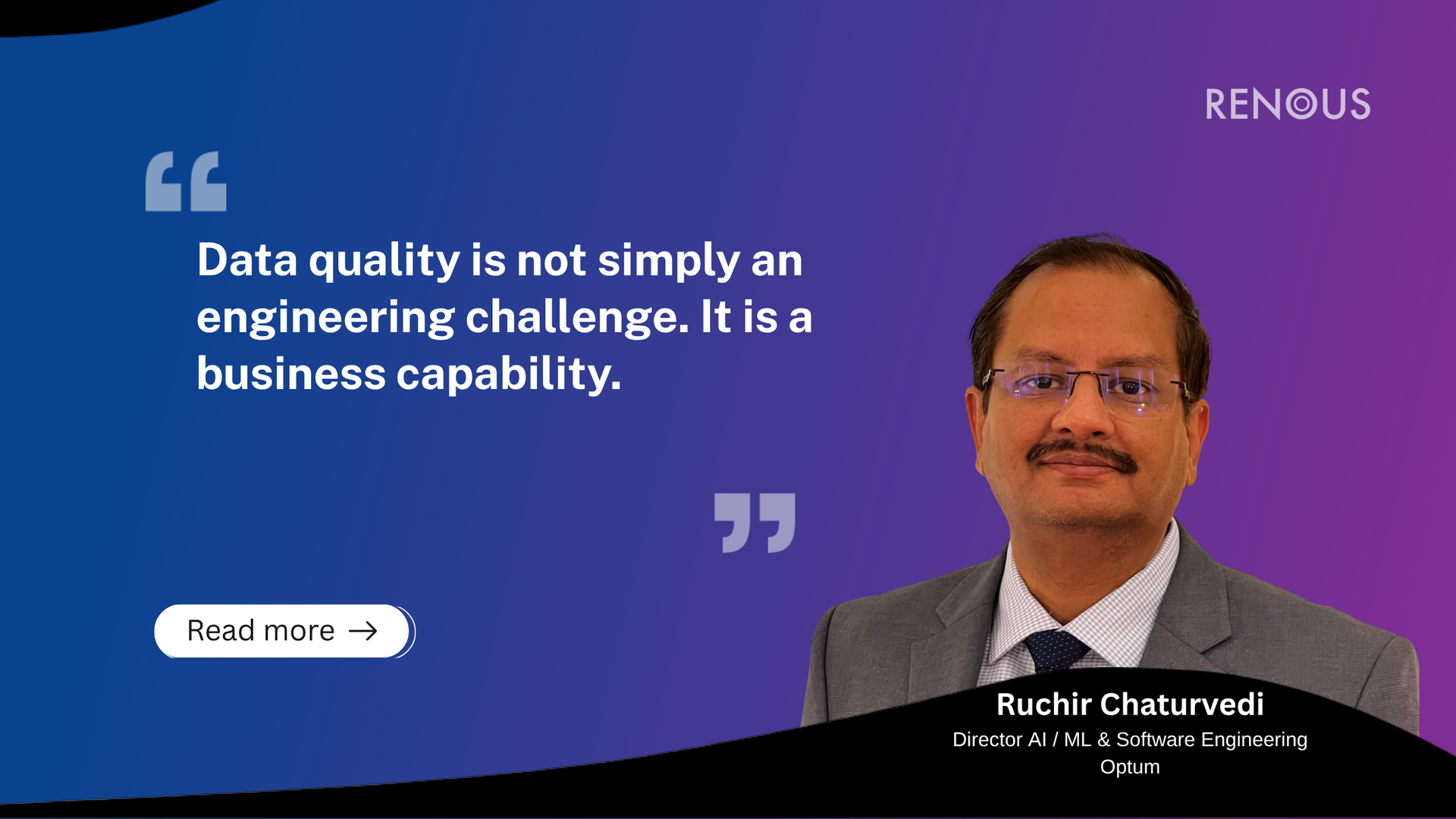
My take on data quality is not simply an engineering challenge. It is an organizational capability. Most AI strategies ultimately become data strategies, whether leaders recognize it early or not.
3. Nobody Experiences AI as an Average
Engineers naturally think in percentages. Users think in experiences.
A system may perform exceptionally well most of the time and still lose credibility because of a handful of visible mistakes. People rarely evaluate AI through benchmark scores, model rankings, or accuracy percentages. They evaluate it through everyday interactions. Can they rely on it? Can they use it to make better decisions? Does it genuinely save time, or does it create more work?
This is why perceived accuracy matters almost as much as actual accuracy. A single high-profile mistake can outweigh hundreds of successful outcomes in the minds of users. Organizations that recognize both the technical and human dimensions of trust are far more likely to achieve sustained adoption.
What I have observed:
Adoption is driven by user confidence, not by model metrics. Users do not experience benchmark scores. They experience outcomes.
4. Governance Does Not Slow Adoption. Uncertainty Does.
Governance is often portrayed as the enemy of innovation. In reality, uncertainty is usually the bigger obstacle.
Whenever AI begins influencing decisions, workflows, employees, or customers, stakeholders naturally ask important questions. What happens when the output is wrong? Who owns the final decision? When should a human intervene? How are risks monitored? What safeguards are in place? How is sensitive information protected?
When these questions remain unanswered, adoption slows. People hesitate because they are unsure where responsibility begins and ends. When these questions are addressed early and transparently, confidence grows.
The organizations making meaningful progress with AI are not eliminating controls. They are building clear and understandable controls that enable responsible innovation.
Governance is not a control mechanism. It is a confidence mechanism.
5. Human-in-the-Loop Is a Design Choice
One of the most persistent misconceptions about AI is that success means removing people from the process. In practice, the opposite is often true.
AI excels at repetitive, high-volume activities such as classification, extraction, summarization, and content generation. Humans remain uniquely effective at judgement, context, empathy, accountability, and navigating ambiguity. The most effective solutions recognize these complementary strengths and are designed accordingly.
The goal should not be to remove human involvement wherever possible. The goal should be to ensure that people spend their time where human judgement creates the greatest value. Organizations that embrace this approach typically see stronger adoption because employees view AI as an enabler rather than a replacement.
I believe the future of work is not human versus AI. It is human plus AI.
6. The Biggest Risks Are Often Not Technical
Technical teams naturally focus on issues such as latency, scalability, performance, and cost. These risks matter and should not be ignored.
However, they are rarely the risks that concern business leaders most. Leaders tend to worry about different questions. What happens if employees stop trusting the system? What happens if customers lose confidence? What if an important decision is challenged? What if the organization’s reputation is affected?
These concerns extend beyond technology into operations, governance, culture, and brand. They are often more difficult to address because they involve people rather than systems.
Technology can usually be repaired. Confidence is much harder to rebuild.
7. Projects Solve Once. Platforms Solve Repeatedly.
Many organizations celebrate a successful AI use case. Fewer recognize the real asset that was created in the process.
The greatest value often comes not from the solution itself but from the capabilities developed along the way. Governance frameworks, evaluation approaches, monitoring practices, review mechanisms, integration patterns, and operational playbooks become reusable assets that can accelerate future initiatives.
This is often the difference between organizations that experiment with AI and organizations that scale it. The former focus on individual projects. The latter focus on building repeatable capabilities that make every future deployment faster, safer, and more effective.
Projects solve problems once. Platforms create the ability to solve many problems repeatedly.
The Leadership Takeaway
The biggest surprise about enterprise AI is that the hardest problems are rarely technical.
Models improve. Infrastructure scales. Costs eventually come down. What remains difficult is creating confidence: confidence that outputs are reliable, confidence that safeguards are effective, and confidence that people continue to exercise judgement where it matters most.
Ultimately, enterprise AI is not just a technology challenge. It is a trust challenge.
The organizations that create the most value from AI will not necessarily be the ones deploying the largest number of models. I expect they will be the ones that build systems people are willing to rely on when the stakes are real.
Because the difference between an AI demonstration and an AI capability is not intelligence.