 Vantage
Engaging the Whole Human Being
When we are healthy, almost everything feels important. When we are unwell, health becomes the only thing that matters.
It is a simple thought, but one that becomes surprisingly profound when we bring it into the workplace. When an employee walks through the office door, they do not leave the rest of their life behind. They arrive with a much larger thought bubble — their physical health, emotional wellbeing, family, finances, relationships, ambitions, anxieties, sleep and responsibilities. Some of these are visible; most are not. Yet all of them can influence the person making a decision, solving a problem, leading a team or simply trying to get through a demanding day.
We may employ a person for a role, but we engage a whole human being. This is where our conversation about workforce health needs to evolve.
Measuring What Actually Changed
For years, organizations have approached employee health through access and programmes: health insurance, annual health checks, teleconsultations, employee assistance programmes, wellness initiatives and mental-health interventions. These are important. But the way we measure them is still often rooted in activity — how many people participated, how many consultations took place, how many health checks were completed.
The more consequential question is: what changed?
Did we identify a risk earlier? Did someone receive the right intervention at the right time? Did behavior change? Did health outcomes improve? Did the health of the workforce move in the right direction?
That shift matters because health does not simply affect whether someone is at work; it can affect how effectively they are able to work. Absenteeism is visible. Presenteeism is not. An employee may be at their desk, attending meetings and answering emails while managing chronic pain, poor sleep, anxiety, fatigue or an undiagnosed condition. They are physically present, but their capacity may not be what it ordinarily is.
The World Health Organization recognizes that mental health and work are closely intertwined, and that poor mental health can affect productivity, performance, absenteeism and staff retention.
Rethinking Work-Life Balance
This also makes me question the way we have traditionally spoken about work-life balance. It is time we thought about the concept of life-work balance too. A parent who has spent the night caring for an unwell child does not become a different person when they log in at nine. Someone caring for an ageing parent does not leave that responsibility outside the office. Life and work are not two sealed compartments.
This does not mean organizations should intrude into people's private lives. It means we need to recognize the human context in which work happens. And that responsibility cannot rest entirely with the employee. Workload, working hours, autonomy, leadership, culture and the way work is organized can all influence health. The World Health Organization's current guidance similarly places emphasis on addressing working conditions and organizational risks, alongside individual support.
From Access to Prevention
So, what should corporate healthcare look like next?
I believe the conversation is moving from access to prevention, from participation to personalization, and from activity to outcomes.
A recent study from our organization provides an interesting perspective on this transition. Drawing on research with organizations and conversations with CHROs and wellness leaders across sectors, the study examines how workplace wellbeing is evolving from a largely programme-led approach towards more integrated models of care and engagement.
One finding particularly caught my attention. Most of the organizations surveyed offer diagnostics as part of their continuum of care, yet the study identifies follow-through and continuity of care as a gap.
It is an important distinction. We are becoming better at finding the signal. The next challenge is acting on it.
An annual health check is valuable, but it is also a snapshot. Its real value lies in what happens afterwards: whether a risk is understood, whether the employee receives appropriate guidance, whether care continues and whether the intervention makes a difference over time.
From Digital Adoption to Health Intelligence
This is where technology can change the equation.
Healthcare has always generated enormous quantities of data, but much of it has traditionally existed in fragments — a diagnostic report in one place, a consultation in another, pharmacy information somewhere else and a health assessment in yet another system. The employee experiences one health journey; the organization may see a collection of disconnected events.
The study found that a majority of surveyed organizations use digital platforms to book and manage health services. Yet, among organizations using digital services, well under half have implemented a utilization dashboard to monitor engagement and outcomes.
Digital adoption is not the same as health intelligence.
Putting healthcare onto an app is useful. The greater opportunity is to use data and artificial intelligence to understand patterns, identify emerging risks, personalize interventions and assess what is changing over time.
Imagine moving beyond knowing how many employees completed their annual health checks to understanding what those assessments reveal about emerging health risks, where intervention may be needed, what intervention is appropriate and whether it is making a measurable difference.
That is where AI becomes interesting — not simply as an automation tool, but as a means of turning fragmented information into timely, contextual intelligence.
It also changes the question a business leader can ask. Instead of “How many people used our wellness programme?”, we can begin asking:
“What is changing in the health of our workforce, and what are we doing about it?”
It is a more strategic question.
Intelligence with Responsibility
There are signs that this conversation is already moving beyond the traditional boundaries of HR. The study notes that most organizations surveyed have CXO-level wellness sponsorship, suggesting that workforce wellbeing is increasingly being considered as part of the wider enterprise agenda.
But greater intelligence must come with greater responsibility. Health is deeply personal. The objective cannot be to create another mechanism through which employees feel watched or judged. Health information should never become a proxy for assessing someone's performance, potential or career.
The value lies in understanding population-level patterns, enabling earlier intervention and creating healthier working environments, with privacy, consent, security and clinical governance at the centre. The future of workforce health is likely to depend not only on how intelligent our technology becomes, but on how trustworthy it remains.
Workforce Health as a Business Metric
So, should workforce health become a genuine business metric?
I do not think the answer is to create one more number on the corporate dashboard. Health is far too complex for a single score, and not every aspect of human wellbeing can — or should — be reduced to a financial return.
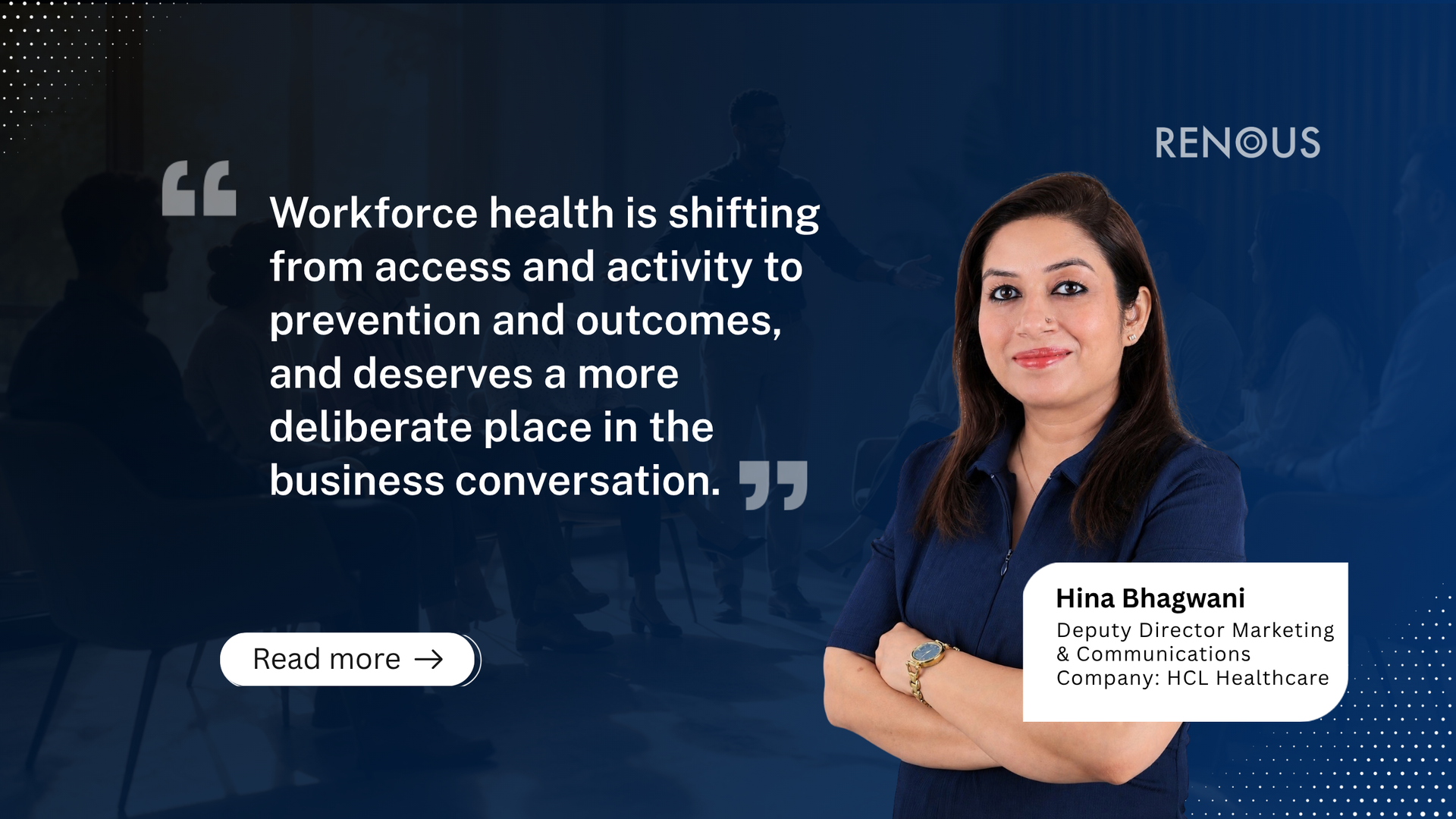
But businesses already measure outcomes influenced by human capability: productivity, engagement, retention, absenteeism and resilience. If health is one of the underlying conditions through which that capability is expressed, it deserves a more deliberate place in the business conversation.
The metric itself may not be singular. It could bring together health risk, prevention, access to care, continuity, behavioral change and outcomes, viewed over time and understood alongside the wider workforce context.
A Shift in Perspective
What matters is the shift in perspective: from health as a benefit to health as intelligence; from activity to outcomes; from a health check as an event to a health journey.
We have spent decades becoming increasingly sophisticated at measuring the performance of businesses. The next evolution is to understand better the human condition that enables that performance.
Because when we are healthy, almost everything feels important. And when health falters, everything else can become harder.
Workforce health does not need to become another number on the dashboard. It should be one of the signals that tell us whether the organization behind those numbers is healthy too.