 Vantage

She Ignored Two Years of Ads, Then Changed Her Mind Over One Sentence at Dinner.
She is the CFO of a mid-sized manufacturing company in Gurgaon, and for two years an ERP company has been trying to reach her.
Its ads sit between her LinkedIn updates every morning, a smiling finance team in front of a clean dashboard. A brochure on "the future of finance" arrives by courier, and her assistant files it with the others. A sales rep writes every Tuesday at 10 a.m., politely, without fail. At an industry conference last year, the company had the biggest booth in the hall and the best coffee, and she walked past it twice. She knows the name well. She has never taken the call.
Then one Thursday evening, at a dinner for eight in a private room, the CFO of a company she respects leans back and mentions something in passing. They moved their month-end close to that same ERP, and it took four days off the process. "My team actually goes home on the first of the month now," he says, and reaches for the bread. There is no pitch. It is one sentence, said between the main course and dessert.
At 9:15 the next morning, she asks her assistant to find the number of that ERP company.
The most important moment in this sale will never appear in any report.
The vendor's marketing team will count this as a win. In their attribution report it will show up as "direct traffic," or as the last ad she happened to scroll past. The dinner will not appear anywhere.
The single most important moment in a two-year sales cycle happened in a room the company was not invited to, through a person it did not pay, in words it did not write.
"At the senior level, it is close to the only story."
This is not a rare story.
By lunchtime, a CFO has already said no to more people than most of us meet in a week.
Spend a day beside a CFO and count the asks. A banker wants twenty minutes. A consulting firm wants to "share a perspective." Three vendors want a demo, two recruiters want a call, and a founder somebody introduced on WhatsApp wants "just your thoughts." By lunchtime, saying no has become a reflex. At that level it is not rudeness. It is part of the job.
So the filters thicken. An assistant screens the calls. An inbox rule moves anything with "webinar" in the subject line. The ads are scrolled past without being read. Not because senior people are cynical, but because they have learned that every message from a brand comes with an incentive attached. The brand wants the deal. Of course it says the product works.
Behind every senior no is a fear that has nothing to do with your product.
There is also a quieter fear.
Six months after a failed ERP rollout, a CFO sits across the table from her board, explaining why the quarter closed late and the numbers do not reconcile. Nobody in that room cares how good the vendor's ads were. A senior decision that goes wrong does not just cost money; it costs reputation.
The old line "nobody ever got fired for buying IBM" was never really about IBM. It was about safety. When the stakes are that personal, the real question a senior buyer asks is not "is this good?" It is "has someone like me trusted this, and survived?"
"A brand cannot answer that question. Only a peer can."
The trust you keep sending down to buyers has never traveled in that direction.
Most marketing is built to travel downward. The brand speaks; the buyer listens. Campaigns, ads, sales decks and sponsored content all flow in the same direction, from the company that wants to sell to the person who might buy.
At the top, trust does not travel that way. It moves across, between people who sit at similar tables, carry similar risks and have nothing to sell each other. A peer has no quota. A peer has sat in the same budget meeting at 8 p.m., faced the same board, made the same mistake last year. When a peer says "it works," the sentence carries a weight that no amount of advertising can manufacture.
Senior leaders rarely make up their minds on stage. They do it in the corridor afterward.
Watch a CHRO at an industry conference. During the keynote, she is half listening and half clearing email on her phone. The real conversation starts after the session, in the corridor, over cold coffee, when a peer from another company leans in and quietly says, "Do not do what we did."
The same thing happens far away from any event. A former colleague sends a WhatsApp message: "Read this, it is exactly our problem." An article written by another leader about what went wrong gets forwarded around a leadership team on a Sunday evening, with one line on top: "Worth ten minutes."
No brand planned any of these moments. Yet this is where senior minds actually change.
The thing that closed the deal is the one thing your dashboard cannot count.
If most B2B marketers already sense this, why do budgets still go to talking down?
Sit in on a quarterly marketing review. On the screen is a dashboard: impressions up 40 percent, cost per lead down, 312 meetings booked. Everyone in the room can read it. The board can read it. It fits on one slide.
Now try to put the Thursday dinner on that slide. There is no number for it, no line item, no campaign code. It cannot be approved, because it cannot be counted.
"What is easy to measure gets funded. What actually moves the decision is often invisible."
That gap is where most B2B marketing money goes to be quietly ignored.
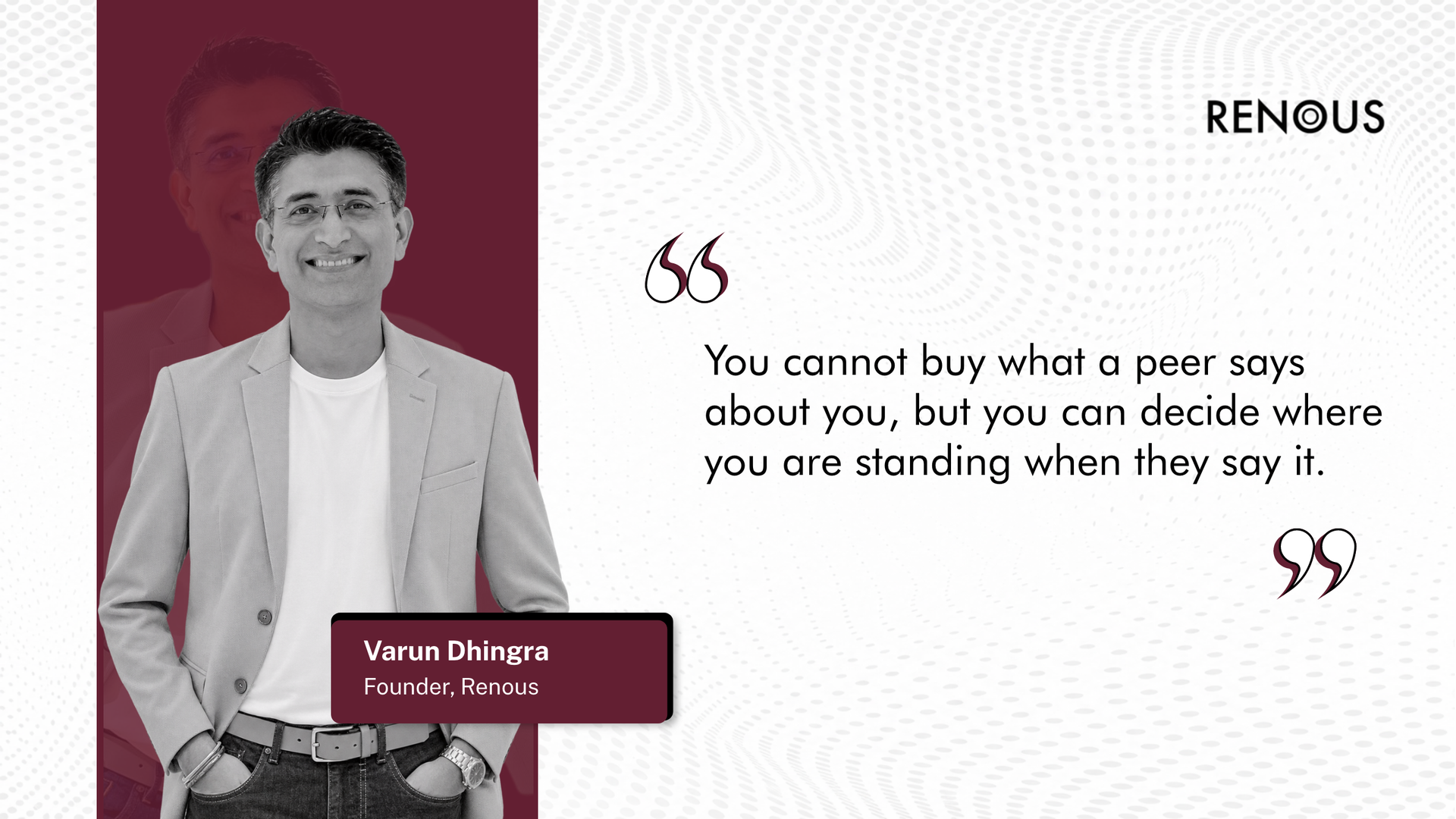
You cannot buy what a peer says about you, but you can decide where you are standing when they say it.
Here is the hard part. You cannot buy what another company's CFO says about you. The moment a peer recommendation is paid for, it stops being a peer recommendation. Senior buyers can smell the difference instantly.
But peer conversations do not happen in a vacuum. They happen in particular places: closed rooms where leaders speak frankly because no one is recording, journals where they write about what they have actually learned, forums where they read each other before they read anyone else.
Brands can choose to stand in those places. Not as the loudest voice, but as the one that made the conversation possible.
Sponsorship once meant something very different, and the old version worked better.
This is an old idea that has been half forgotten.
Long before sponsorship meant a logo on a lanyard, it meant paying for the orchestra and then sitting quietly in the audience while the music played. The patron was not remembered for what they said. They were remembered for what they made room for. Their name became attached to something people valued, and the trust transferred without a single advertisement.
The same thing happens today, at a smaller scale, every time a senior reader finishes a piece by a peer they respect, nods at the last line, and notices, almost in passing, who stood behind it.
The brands that win senior buyers do five things most marketing teams never try.
If your buyers are senior, and they mostly listen to each other, a few things follow.
Find the argument your buyers are already having. Not the topic you wish they cared about, but the one they are debating at dinner right now. CFOs arguing about how much of finance AI can really take over. CHROs arguing about whether hybrid work has quietly failed. GCC leaders arguing about whether India is still a cost play. Your brand belongs next to the debate, not next to your own product.
Back the voices, not the stage. The value is in the leaders who are speaking, not in the size of the event or the reach of the post. Ten senior people your buyers respect will do more for you than ten thousand impressions from people who will never sign.
Stay longer than feels necessary. Association compounds; campaigns decay. A brand that stands behind one conversation for a year becomes part of how people remember that conversation. A brand that appears for one quarter is just another sponsor whose name nobody can recall.
Keep your logo quieter than the ideas. If a reader notices you before they notice the thinking, you have become an ad again, and they will treat you like one.
"The goal is to be noticed second, and remembered first."
Change the question you ask in first meetings. Instead of asking which campaign brought someone in, ask where they first heard of you, and listen for names rather than channels. "My counterpart at a bank mentioned you." "I read something your client wrote." You will start to see how much of your pipeline was really built by people who never worked for you.
Somewhere tonight, someone is deciding about you at a table you are not sitting at.
The CFO at that dinner will never know she was part of a sales cycle. The peer who spoke will never know he closed a deal. The ERP company will never see the moment in a report.
"The most persuasive sentence ever said about your company may be one you never hear."
You cannot write it. But you can decide whether you are close enough to the conversation, and trusted enough by the people in it, for that sentence to be said at all.