 Vantage
The Meeting That Felt Familiar
A few months ago, I attended a discussion on AI adoption. The room was full of enthusiasm. Teams were showcasing use cases, leaders were sharing productivity gains, and everyone was talking about how quickly AI was becoming part of everyday work. The conversation moved from customer service and operations to software development, data analysis and decision support. Almost every example pointed in the same direction: move faster.
As I listened, I felt I had seen this story before.
Not AI itself, but the excitement that arrives whenever a powerful new technology enters the workplace. Over the course of my career in banking and model risk, I have watched advanced analytics, predictive models and automation move from experimentation into business-critical processes. Each wave promised faster decisions, lower costs and better customer experiences. Many of those promises became reality.
But banking also learned something important: the difficult part rarely appears during the demonstration. It appears later, when the technology becomes part of everyday business and people begin depending on it.
Banking Is Betting Big on AI
There is good reason for the excitement. Generative AI has the potential to create significant value across banking — from improving customer service and employee productivity to supporting software development, fraud detection, analytics and decision-making.
The scale of adoption is already visible. AI is moving beyond innovation labs and pilot programmes and into the daily rhythm of financial institutions.
That momentum is positive. Banks can use AI to reduce repetitive work, identify unusual activity earlier, improve customer interactions and help employees make better-informed decisions.
But there is another part of the story that receives less attention: making sure responsibility grows at the same pace as capability.
A Lesson Banking Learned Long Ago
Long before generative AI entered public conversation, banks were already using models to support lending decisions, detect fraud, monitor transactions, estimate risk and manage capital.
The technology has changed, but one principle has remained remarkably consistent:
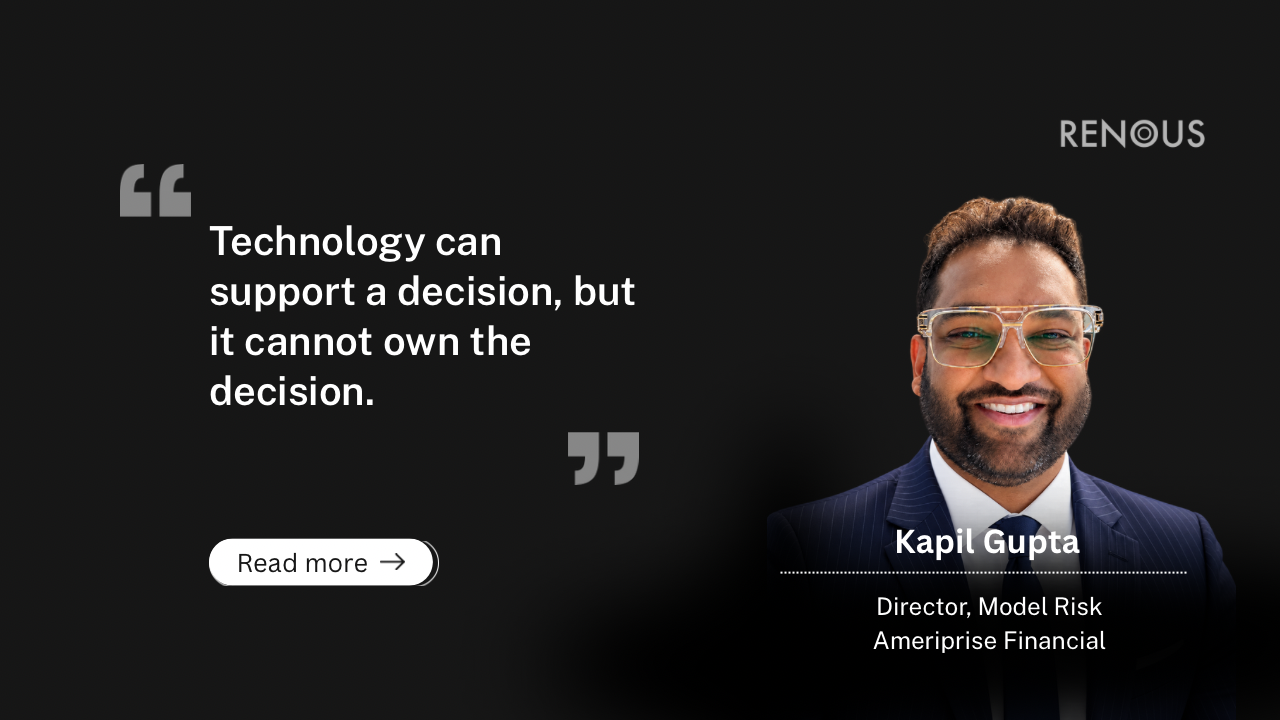
“Technology can support a decision, but it cannot own the decision.”
When a lending process produces an unfair outcome, responsibility remains with the institution. When a fraud control misses suspicious activity, the bank remains accountable. When an automated process creates an unintended customer impact, the explanation ultimately has to come from people, not from the system.
Banking learned this through years of experience, regulation and public scrutiny.
AI does not remove that principle. It makes it more important.
Modern AI can write, summarize, recommend, search and increasingly take actions. A recommendation that once required hours of analysis can now appear in seconds. That efficiency is valuable. But speed does not transfer responsibility from the institution to the technology.
Technology Is Moving Faster Than Governance
The defining feature of the current AI wave is speed. New capabilities arrive quickly, products evolve rapidly, and businesses understandably feel pressure to avoid falling behind.
Governance moves differently.
Financial institutions need to understand how a technology is being used, what could go wrong, where customers or employees could be affected, and what controls are appropriate. Those questions take time.
This does not mean organizations should wait for every uncertainty to disappear before adopting AI. Nor does it mean governance should become a brake on innovation.
The better approach is to build accountability into adoption from the beginning.
Banks have navigated similar transitions before. New products, digital channels, analytics and automation often developed faster than the risks around them could be fully understood. The institutions that handled those transitions well did not stop innovating. They clarified ownership, established controls and kept human judgment close to decisions carrying meaningful consequences.
Accountability Is the Part Nobody Can Delegate
When credit scoring became more sophisticated, banks remained accountable for lending decisions. When fraud systems became more advanced, banks remained accountable for protecting customers. When automation transformed operations, accountability did not move from the institution to the technology.
AI changes the scale and speed of influence. It does not change where responsibility sits.
This is why accountability needs to be designed into AI use from the start.
People need to understand what a system is expected to do, where human review remains necessary, who monitors its performance, and who steps in when its output does not look right. They need to know what happens when the technology behaves differently from what was expected.
These are not barriers placed around innovation. They are the conditions that allow innovation to earn trust and scale responsibly.
For financial institutions, this is particularly important because trust is not an abstract concept. Customers trust banks with their money and personal information. Investors trust institutions with capital. Regulators expect firms to operate responsibly.
AI should strengthen that trust by improving service and decision support — not weaken it by making ownership unclear.
The Real Opportunity
This is not an argument against AI. Quite the opposite.
I believe AI will reshape banking in meaningful ways, and the potential benefits for customers, employees and institutions are too important to ignore. The right ambition is not slower AI. It is responsible AI that can be used with confidence.
The strongest financial institutions will not be known only for how quickly they adopted the technology. They will also be known for how clearly they connected innovation with responsibility.
They will give their people the freedom to use AI while maintaining appropriate safeguards around sensitive data and important decisions. They will be transparent about where human judgment still matters. And they will be willing to learn when outcomes do not match expectations.
Banking has spent decades demonstrating that innovation and accountability can coexist.
The AI era does not change that lesson. It brings the lesson back into focus.
“Technology will continue to advance, and financial institutions should move with it. But lasting value will come from those that move forward without leaving responsibility behind.”