 Vantage
There is a question I increasingly find myself asking when I look at the evolution of Global Capability Centres:
If the success of a GCC is still primarily measured by how many people it has, are we really measuring the right thing?
The first Renous GCC Sentiment Index makes me believe this question is becoming increasingly important.
The sentiment is clearly positive. The Index stands at 154, with 76% of leaders expecting AI budgets to increase and 61% expecting their GCC mandate to expand. At the same time, 41% expect GCC headcount to remain flat or decline.
That combination is fascinating.
- More mandate
- More technology investment
- Less dependence on headcount.
To me, this signals that the GCC industry is entering its next phase.
I believe the next GCC race will not be won by the centres that scale fastest. It will be won by those that compound capability the fastest.
And this is something that has become very real for me while building REA Cyber City.
We Didn't Set Out to Build a GCC
From day one, we were deliberate about what we wanted to build. Our ambition was to extend REA’s engineering capability by establishing teams in India that worked in the same way as our teams in Australia, with shared innovation principles and philosophies across REA’s global engineering community, and clear ownership of both the work and outcomes.
That distinction has profound consequences. If you are building for capacity, you ask:
- How many people can we hire?
- How much work can we transition?
- How quickly can we scale?
If you are building for capability, the questions become:
- What can this team own?
- What decisions can it make?
- What problems can it solve?
- What outcomes can it influence?
- How much better can the organization become because this capability exists?
That is a fundamentally different ambition. And our experience so far has made us even more excited about the opportunity in India. The enthusiasm we see from our Australian stakeholders when they experience the quality, energy and depth of talent in India has been one of the most rewarding parts of this journey.
It reinforces something I strongly believe:
India's GCC opportunity is no longer about accessing talent. It is about converting that talent into differentiated organizational capability.
The GCC Flywheel: Capability Compounds
This is the mental model we are trying to build around at REA Cyber City. Not a linear model of: Work → People → Scale
But a flywheel:
High-Quality Work → Stronger Talent → Stronger Capabilities → Better Outcomes → Stronger Employer Brand → Better Talent → Higher-Quality Work
The important thing about a flywheel is that each turn makes the next turn easier and stronger. And that changes how I think about GCC leadership.
If you want stronger talent, don't start by asking how to improve your hiring engine. Start by giving people better problems to solve.
If you want a stronger employer brand, don't start with employer branding campaigns. Start by creating work that talented people are proud to talk about.
If you want more strategic work from HQ, don't ask for more strategic work. Earn it through consistently better outcomes.
This is where the GCC model starts to become self-reinforcing.
The objective is not to build a bigger GCC. It is to build a GCC that gets better every time the flywheel turns.
Mandate Is Not the Same as Autonomy
Another finding in the Renous Index caught my attention: 61% of GCC leaders say their mandate is expanding. But there is an important question behind that number:
Is the GCC being given more work or more ownership?
Those are not the same thing. You can expand a GCC's mandate while keeping all the important decisions at HQ. That creates a centre that is larger, busier and perhaps more sophisticated but not necessarily more empowered.
When we designed REA Cyber City's operating model, we consciously chose decentralized autonomy within clear guidelines from HQ.
For me, that is an important balance.
HQ provides: Direction. Principles. Guardrails. Context.
The Centre provides: Execution. Decisions. Accountability. Speed.
It avoids two extremes:
- Too much centralization creates dependency and slows execution
- Too much decentralization can create fragmentation and divergence
The goal is not autonomy for its own sake. It is autonomy with alignment for faster execution.
And I believe this becomes increasingly important as GCCs mature.
Because the real measure of an expanding mandate should not be:
“How much more work has moved to India?”
It should be:
“How many more meaningful outcomes can India own?”
I Don't Think the “8%” AI Finding Tells the Whole Story
The report notes that only 8% say the GCC head has the greatest influence over AI decisions, with influence more commonly sitting with global HQ or technology leadership. I would interpret that differently.
I don't believe AI decisions should necessarily sit with the GCC head.
AI has become far too important for that.
It is now a boardroom discussion.
An executive leadership discussion.
A technology strategy discussion.
A risk and governance discussion.
An operating-model discussion.
And increasingly, a business strategy discussion.
So I don't think the right question is:
“Does the GCC head control AI?”
The better question is:
“Does the GCC leader have a seat at the table where AI decisions are being made?”
That is a very different measure of influence. The future GCC leader doesn't need to own every decision. They need to be credible enough to have a seat at the table for decisions that matter the most. And that requires a different leadership profile, someone who understands technology, business, people, risk and the global operating context.
Influence is not about owning the decision. It is about being trusted enough to shape it.
AI Is Changing the Traditional GCC Model
This is perhaps the most interesting implication of the report.
76% expect AI budgets to increase. Yet average AI maturity is only 3 out of 5. And 41% expect headcount to remain flat or decline.
We should pay attention to what that combination means. AI isn't simply going to make existing GCC employees more productive. It could change the economics and operating model of the GCC itself.
The question shouldn't be:
“How do we use AI to make our engineers code faster?”
It should be:
“If AI fundamentally changes how engineering work gets done, what should the engineering organization look like?”
That is a much harder question. And potentially a much more valuable one. The same applies beyond engineering.
If AI and agentic systems can increasingly execute workflows, analyse information, make recommendations and orchestrate work, then the traditional GCC proposition of people + process + scale is likely to come under pressure.
The report's finding that 81% expect agentic AI to disrupt the GCC's own core functions is therefore particularly significant.
The GCC isn't just going to use AI. I believe AI is going to change what a GCC is.
The New GCC Scorecard
If this is where the industry is heading, perhaps we need to rethink how we measure GCC success. I would argue the scorecard is gradually shifting:
| Yesterday's GCC | Tomorrow's GCC |
| Headcount | Capability density |
| Cost arbitrage | Business value |
| Work transferred | Outcomes owned |
| Processes executed | Problems solved |
| HQ-directed | Autonomous within guardrails |
| AI pilots | AI-native ways of working |
| Talent acquisition | Talent compounding |
| Delivery centre | Strategic capability |
This is not to say that scale or efficiency don't matter. They do. But they are increasingly table stakes rather than the differentiator.
What Building REA Cyber City Has Taught Me
We are still early in our journey, so I don't pretend we have all the answers. But one lesson is becoming increasingly clear to me:
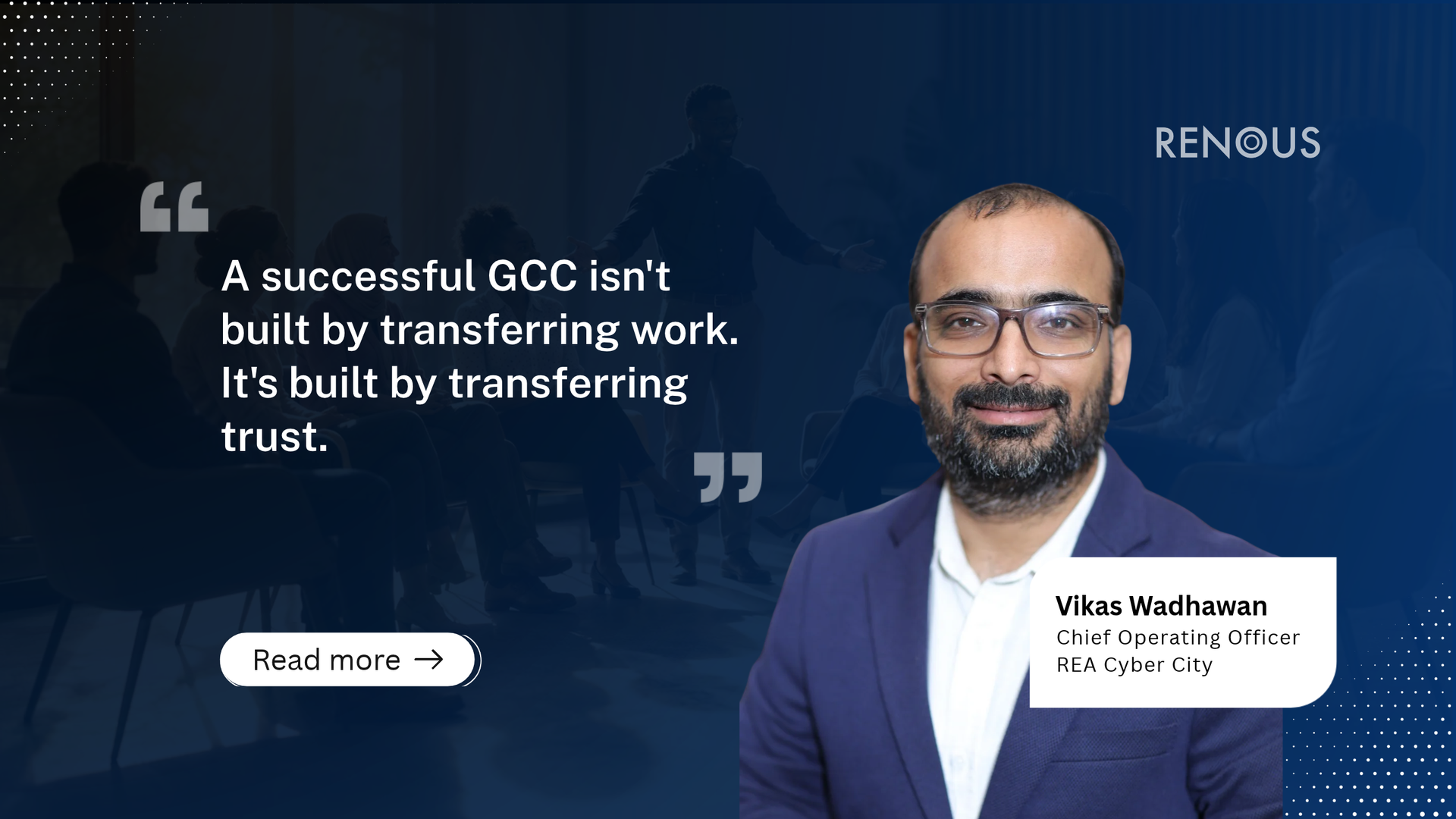
A successful GCC is not built by transferring work. It is built by transferring trust.
You start with work → You demonstrate capability → Capability creates outcomes → Outcomes create credibility → Credibility creates trust → Trust creates greater ownership → Greater ownership creates better work
And the flywheel turns again.
That is what excites me most about what we are building at REA Cyber City. Not the number of people we will eventually have. Not the size of the centre. But the possibility of creating an engineering capability in India that is deeply integrated with REA, empowered to make decisions, and capable of creating greater value.
The Question I Would Leave GCC Leaders With
The Renous GCC Sentiment Index tells us that the industry is optimistic. I am optimistic too. But I think we should challenge ourselves to look beyond the optimism. Because the real question for the next five years is not:
“How big can our GCC become?”
It is:
“What is the value we deliver?”
Can we build teams that tackle the hardest problems?
Can we create environments where the best talent wants to work?
Can we give people meaningful ownership rather than simply more work?
Can we use AI to create disproportionate value rather than simply incremental productivity?
Can we build decision-making models that combine global alignment with local speed?
And most importantly:
Can we create a flywheel where every cycle makes the GCC stronger than the one before?
Because if we can, then we are no longer building a centre. We are building a capability that compounds. And I believe that is the next chapter of India's GCC story.