 Vantage
For years, Global Capability Centres (GCCs) were measured by efficiency, scalability, and cost advantage. Those fundamentals remain important, but the mandate has evolved.
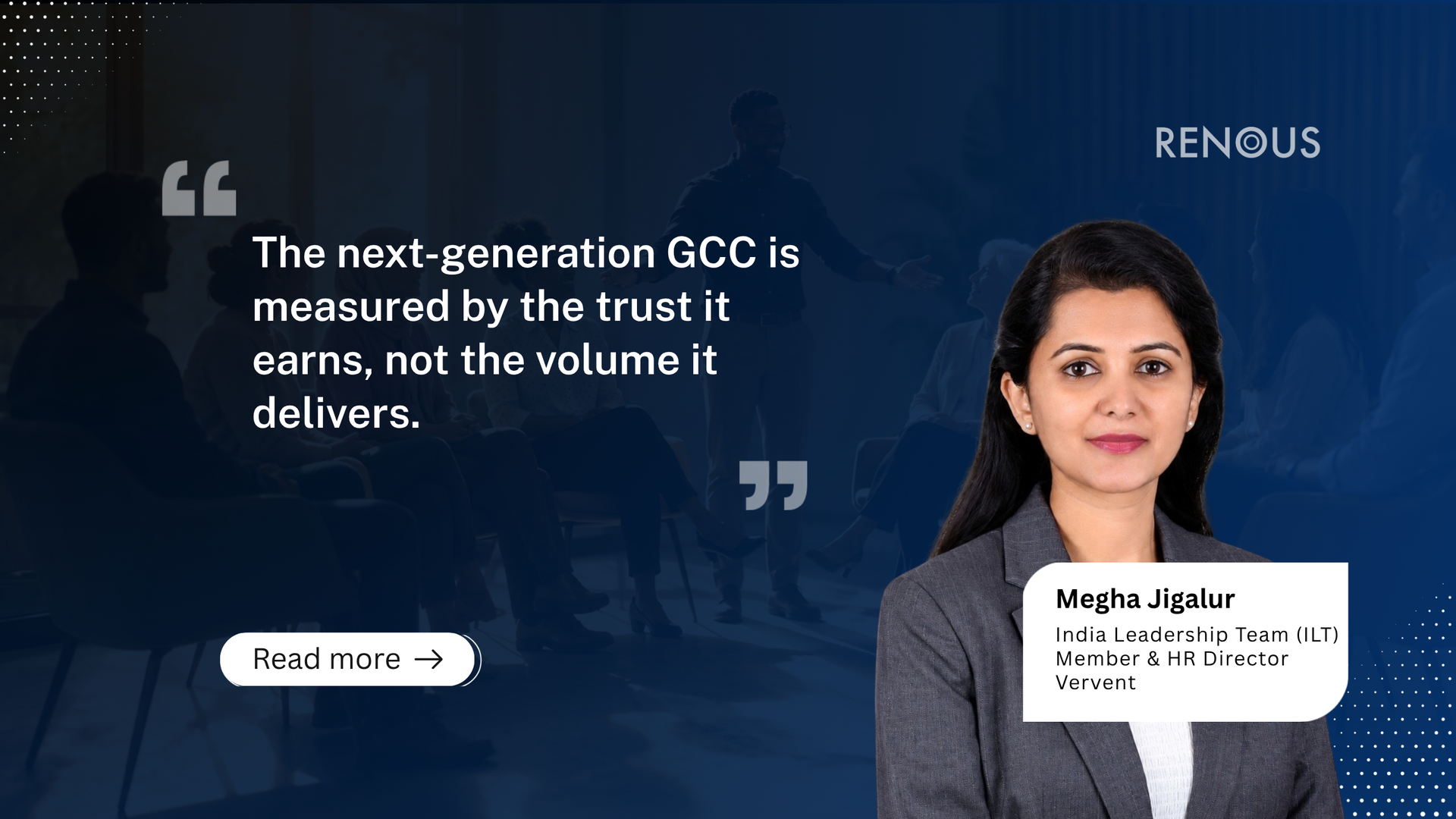
“Today, The true measure of a mature GCC is not the volume of work it delivers, but the trust it earns to influence business decisions.”
As HR leaders, we are in a unique position to witness this transformation.
Increasingly, strategic leadership roles are being entrusted to India—not simply because exceptional talent is available, but because organizations recognize the depth of expertise, leadership capability, and innovation that exists here.
Every new opportunity strengthens the confidence that India is no longer just a delivery destination. It is becoming a strategic partner in shaping enterprise outcomes.
From Execution to Influence
With that shift comes greater responsibility.
Our role is no longer limited to executing global strategies with excellence. We are expected to influence them, challenge them when needed, and help co-create solutions that work across a diverse global workforce.
That requires us to think beyond HR practices and understand the business—the priorities, challenges, and outcomes we are collectively trying to achieve.
The evolution of the GCC therefore demands a corresponding evolution in leadership.
HR leaders must increasingly operate at the intersection of people, business, culture, and strategy.
Global Consistency, Local Relevance
Global consistency is important, but consistency should not come at the expense of relevance.
Whether it is employee benefits, well-being, talent development, or performance programs, the objective is not to create different standards for different countries. It is to build a shared philosophy while thoughtfully adapting to local realities.
Achieving that balance requires more than policy expertise.
It demands:
- Business context — understanding what the organisation is trying to achieve.
- Cultural awareness — recognising that global teams operate through different norms and expectations.
- Leadership confidence — influencing both global and local stakeholders with credibility.
- Practical judgement — knowing where consistency matters and where adaptation creates greater value.
“Global consistency should not come at the expense of local relevance.”
The strongest HR leaders are not those who simply implement global frameworks. They are those who can translate those frameworks into solutions that work in the context of the people and businesses they serve.
Trust Is Earned, Not Given
Building that influence has been one of the biggest leadership lessons in my own journey.
It has not always come easily, and not every initiative has become a success story.
Over time, I have learned that trust is not built through titles or authority. It is earned through consistency, credibility, and the willingness to bring solutions rather than problems.
The conversations that create the greatest impact are rarely the loudest ones. They are the ones grounded in data, business insight, and a genuine commitment to moving the organisation forward.
Influence, therefore, is less about having the strongest voice in the room and more about becoming someone whose judgement others trust.
“Trust is not built through titles or authority. It is earned through consistency, credibility, and the willingness to bring solutions rather than problems.”
Influence Requires Both Humility and Strength
I have also experienced that influence requires humility and strength.
Working across global teams means navigating different perspectives, priorities, and ways of thinking. Disagreements are inevitable, but they do not have to become barriers.
The more we focus on outcomes rather than ownership, and collaboration rather than hierarchy, the stronger the partnerships become.
Credibility grows when people know you are advocating for the business—not for your function or personal viewpoint.
This is particularly important in a GCC environment, where leaders increasingly operate across geographies, functions, and cultures.
The ability to disagree constructively, challenge assumptions respectfully, and still remain aligned to the larger business objective is becoming a defining leadership capability.
Bringing Global Leaders Closer to India
Another lesson that has stayed with me is the power of bringing global leaders closer to the realities of our teams in India.
No presentation or dashboard can replace walking the floor, meeting employees, sharing a meal, and experiencing the culture firsthand.
Those moments create context that data alone cannot provide.
They build empathy.
They strengthen relationships.
And they often lead to better business decisions.
When global leaders experience teams firsthand, they begin to see not only what the team delivers, but how it thinks, collaborates, solves problems, and creates value.
That context can fundamentally change how India is perceived within the wider enterprise.
“No presentation or dashboard can replace experiencing the culture and realities of our teams firsthand.”
The Next-Generation GCC
As I continue my own leadership journey, my belief has become stronger than ever: the future of GCCs will not be defined by geography or cost arbitrage.
It will be defined by:
The quality of leadership we cultivate.
The trust we earn.
The credibility we build.
And our ability to influence enterprise decisions—not simply execute them.
For HR leaders, this is an exciting time.
We have an opportunity to move beyond being enablers of strategy to becoming active architects of it.
And perhaps that is the real evolution of the next-generation GCC:
Not just delivering work with excellence, but shaping the future of the enterprise through influence, credibility, and leadership.