 Vantage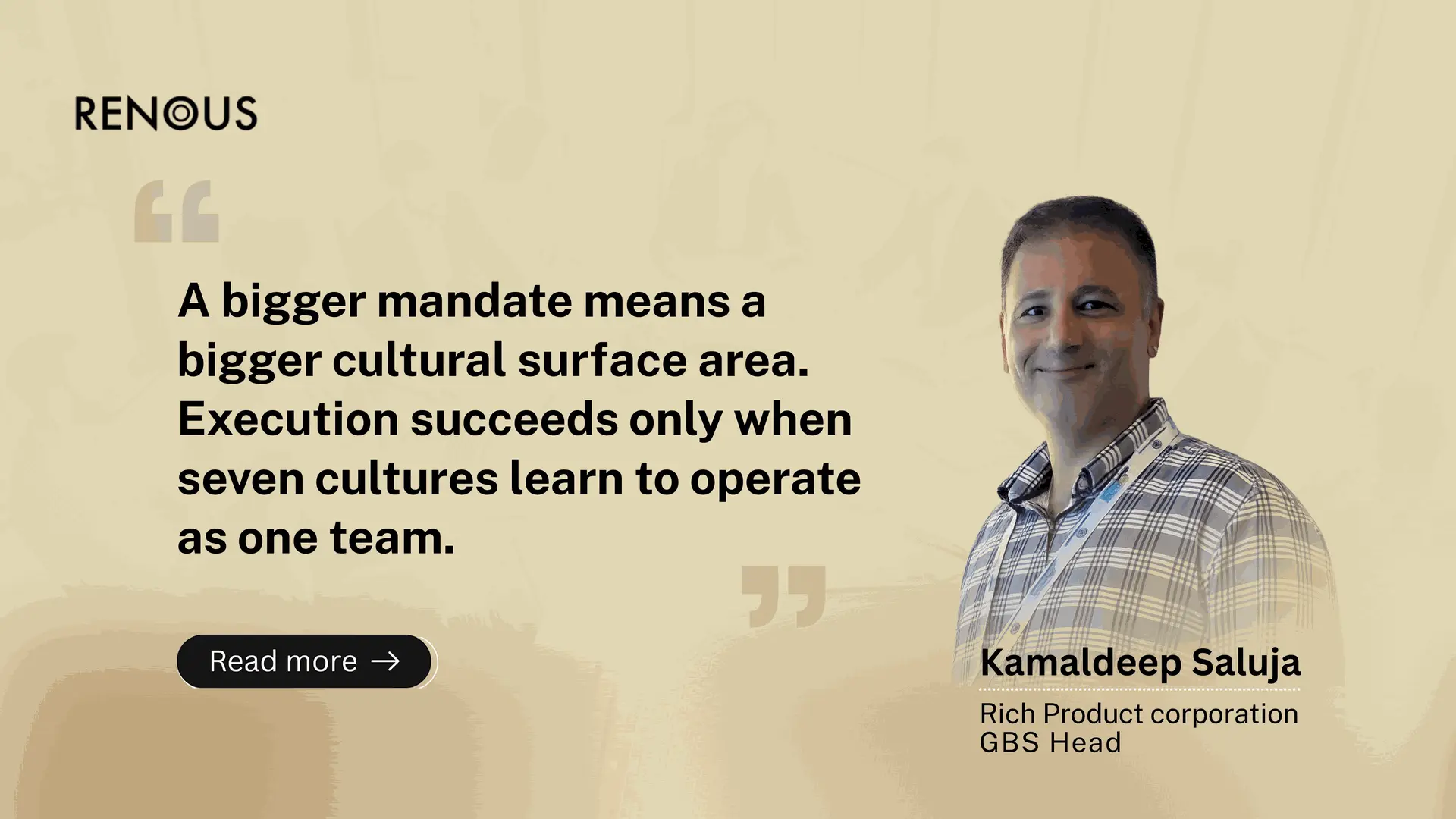
Dalian, 2008. I had flown in to meet the team, and as I always did, I called a huddle. I spoke the way I spoke everywhere — fast, confident, leaning on an operational-excellence example I had used a dozen times before. I thought it landed.
Afterwards, one of the team members — Chinese, Western-educated, refreshingly direct — pulled me aside. I asked him how the huddle had gone. He gave me one word.
“Pathetic.”
Nobody followed you, he said. You spoke too quickly and assumed everyone was already with you. And that example you reached for — there is a history here you didn’t acknowledge, and people noticed.
That evening rearranged how I built every centre after it. Over the next two decades I went on to stand up multi-capability GCC and GBS operations across India, Malaysia, China, Mexico, Brazil, Poland and Romania. The technical playbook travelled well from one to the next. The cultural playbook had to be rebuilt every single time. And the leaders who never learned that distinction are the ones I watched lose perfectly good engagements.
The conversation we keep skating past
Our industry’s conversation right now is all about the mandate — expanding the charter, climbing the value chain, owning outcomes instead of renting out cost arbitrage. I have spent a career making that argument and I believe every word of it. But the mandate conversation keeps skating past one inconvenient truth: an expanded charter does not hold together on an org chart. It holds together on culture.
Say the word “culture” in a room of delivery leaders and you can watch the energy drain out of it. It gets filed under the HR offsite, the values poster, the engagement survey. That is the most expensive mistake in this business.
In a multi-center network, culture is the load-bearing wall. It is what decides whether a Polish architect tells your Indian delivery lead the design is wrong before it ships or after. It is whether a problem in São Paulo surfaces on the Tuesday status call or in the Friday escalation. It is whether your best engineer in Cluj stays for the mission or leaves for a better offer elsewhere. Culture is a delivery risk and an attrition cost long before it is anything as gentle as a values statement. Treat it softly and it will show up hard — in your SLAs, your margins, and your renewal conversations.
One cadence, seven translations
Here is the principle I wish someone had handed me in Dalian: operating models can be standardized; cultures cannot. Run seven locations off one identical playbook and you will get seven mediocre outcomes. The discipline that actually works is to design one operating cadence with seven cultural translations — the same standards, the same scorecards, the same drumbeat, expressed in seven different cultural languages.
Across those seven countries, I have watched multi-hub models fail at the same four seams. Never the contract. Always the seam.
The directness gradient. This is the single most common friction in a multi-hub model, and almost nobody names it out loud. A Polish or Romanian lead who says “this design is wrong” is being helpful — in their cultural code, candor is a sign of respect and engagement. The Indian counterpart on the other end of the call can hear a personal attack. Both are excellent professionals. Both are behaving correctly by their own operating system. And the work suffers because the leader blamed “communication” instead of recognizing a cultural fault line.
The trust-building mode. In Brazil and Mexico, trust tends to be built before the work — through relationship, presence, the human conversation that comes first. In Poland and Romania, trust tends to be built through the work — deliver, prove competence, and the relationship follows. Put a relationship-first culture and a task-first culture on the same project with no translation, and each reads the other as either inefficient or cold. Neither is.
The disagreement channels. Every culture has a legitimate route for dissent — but it is not the same route. In some centers people will challenge you in the open meeting; in others the real conversation only happens in the one-on-one afterwards, or never reaches you at all unless you go and ask for it. A leader who only listens to the open meeting is hearing a fraction of the truth.
Decision speed. What one center experiences as decisive, another experiences as reckless; what one calls thorough, another calls slow. Align the cadence of decisions deliberately, or your fastest center and your most careful center will quietly lose respect for each other.
What belonging actually takes
Belonging is not a town hall and a Diwali email. In a distributed network, identity is something you have to engineer — patiently, locally, and on purpose. A few of the disciplines that have held up for me across every geography:
Give every new joiner a License-to-Operate before you give them a target. They need to understand not just the process but the why behind it, and the cultural ground they are standing on, before they are accountable for an outcome. Onboarding into a culture is as important as onboarding into a tool.
Then ringfence the whole thing with meritocracy. A genuinely meritocratic culture is the most powerful tool I know for cutting through the human biases that quietly distort every multi-region operation — the accent taken more seriously, the time zone heard first, the familiar name handed the stretch role. When people across every region can see that the deserving rise on merit and nothing else, it instils a natural discipline and a shared focus on goals that no target-setting exercise can manufacture. Fairness is the one value that travels intact across all seven countries.
Build identity peer-to-peer, not top-down. I have long used an Each-One-Adopt-Three model — every experienced person actively brings three others along. Belonging spreads far faster through colleagues than through leadership broadcasts, and it survives the leader leaving the room.
Know your stakeholders by name, not by node. I man-to-man mark my key stakeholders across the network — not in a surveillance sense, but in the sense that someone senior is genuinely close to each relationship that matters, in each location, all the time. Distance is the enemy of trust, and the only antidote is deliberate proximity.
Underneath the frameworks sit a few timeless values I will not compromise on, because they are the only ones that hold across every culture. Seek first to understand, then to be understood — most multi-hub friction is simply two people who skipped straight to being understood. Patience, perseverance and respect for the individual — unglamorous, slow to compound, and non-negotiable in any high-performing multicultural team. And name your custodians of the culture: the people in each location who carry it instinctively. Reward them, and let them lead by example. Culture is not changed by the grand announcement; it is changed by gentle reinforcement, repeated every single day, until the compounding effect does the work — and the custodians keep it alive when the leader is asleep in another time zone.
And show up. Physically. The Dalian lesson, in the end, was not really about China — it was about the arrogance of assuming that one cadence, my cadence, was the universal one. You cannot translate a culture you have never sat inside. The leaders who fly in, run the deck, and fly out are the ones who get the engagement they deserve.
The loudest signal is the silence
There is one discipline that underwrites all the others. I have always held that the hardest part of change management is not what is said — it is what is not said. The real signal in a multicultural network life in the pause before someone agrees, the question that never gets asked on the open call, the silence in the townhall that should have been a challenge. So, in every meeting, every one-on-one, every townhall, I am listening and observing as much for the unsaid as the said — using it to keep validating my read of each culture, and to make the adjustment the moment the evidence tells me my hypothesis was wrong. You never finish learning a culture. You only keep updating your understanding of it.
The mandate lives or dies here
In a multi-country GCC, culture eats into strategy at the breakfast table -- every single morning. After two decades and seven countries, I would put it more bluntly: in a multi-country GCC, culture eats into strategy at the breakfast table — every single morning, across every time zone, whether you are in the room or not.
So, by all means expand the charter. Climb the value chain. Win the bigger mandate. But understand what you are actually signing up for. A bigger mandate is a bigger cultural surface area, more seams, more translation, more of the patient, unglamorous work of making people in seven countries feel like one team.
The mandate is not won in the boardroom where it is awarded. It is won, or lost, in the thousand small cultural translations that decide whether your network actually holds together when the execution pressure arrives.
That young man in Dalian gave me the most valuable feedback of my career in a single word. The least I can do is pass on what it cost me to learn.
About Author
Kamaldeep Saluja is a GCC leader with 25+ years building multi-capability, multi-country delivery operations across India, Malaysia, China, Mexico, Brazil, Poland and Romania. He has led from all three vantage points of the GCC world — as a captive operator, a service provider, and a buyer governing a provider — and writes on the leadership, culture and operating discipline behind high-performing global capability centers.
Find him on LinkedIn: Kamaldeep Saluja
Disclaimer from Renous
The opinions expressed in this article are those of the guest author and do not necessarily reflect the views of our publication. The information provided in this article is for general informational purposes only and should not be considered as professional advice. The reader should always conduct their own research and due diligence before taking any action based on the information provided in this article.