 Vantage
My career has been shaped by several pivots: from founder to student, from India to the United States and back to a global operating role, and from building one company to helping lead a larger organization across functions and geographies.
Each transition looked logical from the outside. None of them felt easy from the inside.
From Founder to Student
In the early 2010s, I made the difficult decision to exit my first startup. It was not simply a financial or strategic decision. I had received a scholarship to pursue business education at a leading healthcare-focused university in the United States, and I felt a responsibility to honor that opportunity. Leaving a company I had helped build was emotionally complicated, but it opened the next chapter of my journey.
Business school gave me a new lens on healthcare, innovation, and entrepreneurship.
After graduation, I had the opportunity to serve on the venture arm of Mayo Clinic, a globally renowned hospital. That experience had a lasting impact on me. It exposed me to the possibilities at the intersection of medicine, technology, and patient outcomes, and it sparked a passion for digital therapeutics that continues to shape my work today.
“Business school gave me a new lens on healthcare, innovation, and entrepreneurship.”
Returning to Entrepreneurship
A few years later, I returned to entrepreneurship and co-founded a mental health startup.
Building that company was intense, personal, and deeply rewarding. We were solving a problem that mattered, while navigating the uncertainty that comes with creating something from scratch.
In 2021, the company was acquired by Dario Health.
The acquisition brought another major pivot.
From Founder to Global Capability Center Leader
I moved from being a founder to becoming the Director of the company’s Global Capability Center in India.
This transition was more difficult than I expected.
As a founder, I was used to setting direction, making decisions quickly, and operating with a high degree of autonomy. After the acquisition, I had to learn how to receive mandates from headquarters, translate them into local execution, and operate within a larger system of governance, priorities, and dependencies.
“That required a change not only in responsibilities, but in mindset.”
I had to stop seeing structure as a constraint and start seeing it as a platform for scale. I also had to understand that influence in a global company is not always expressed through ownership of every decision.
Often, it comes from building trust, creating clarity, and delivering consistently across boundaries.
The U-Curve of Confidence
The transition followed what I think of as a U-curve.
Initially, the confidence that came naturally as a founder dipped. I had to prove my value in a new environment, where my contribution could not be measured only by the speed of decisions or the size of a team I directly controlled. There was a period when I questioned whether I was creating enough value beyond reducing costs or keeping operations running.
Over time, that perspective changed.
I learned to demonstrate value through business impact — building capabilities, improving execution, connecting teams, and creating leverage for colleagues in other countries. I began to see that a capability center should not be viewed merely as a lower-cost delivery model.
“It can be a source of ideas, leadership, resilience, and competitive advantage.”
From Capability Center to Global Business Responsibility
As my confidence grew, so did the scope of my role.
In addition to leading the Global Capability Center, I took responsibility for Dario’s global medical-device supply chain.
That was another shift — from leading a center primarily through people and operations to influencing a business-critical function across countries, products, suppliers, and customer commitments. I found that transition satisfying because it brought me back to the business front.
I was once again able to influence outcomes beyond my immediate geography, while drawing on everything the earlier pivots had taught me:
- Entrepreneurial ownership
- Healthcare perspective
- Cross-cultural collaboration
- Operational discipline
Looking Back: Connected Chapters, Not Career Breaks
Looking back, I no longer see these moves as breaks in a linear career. “They were connected chapters.”
The founder experience taught me ownership.
Mayo Clinic taught me the importance of mission and evidence in healthcare innovation.
The acquisition taught me how to integrate into a larger organization without losing the ability to create.
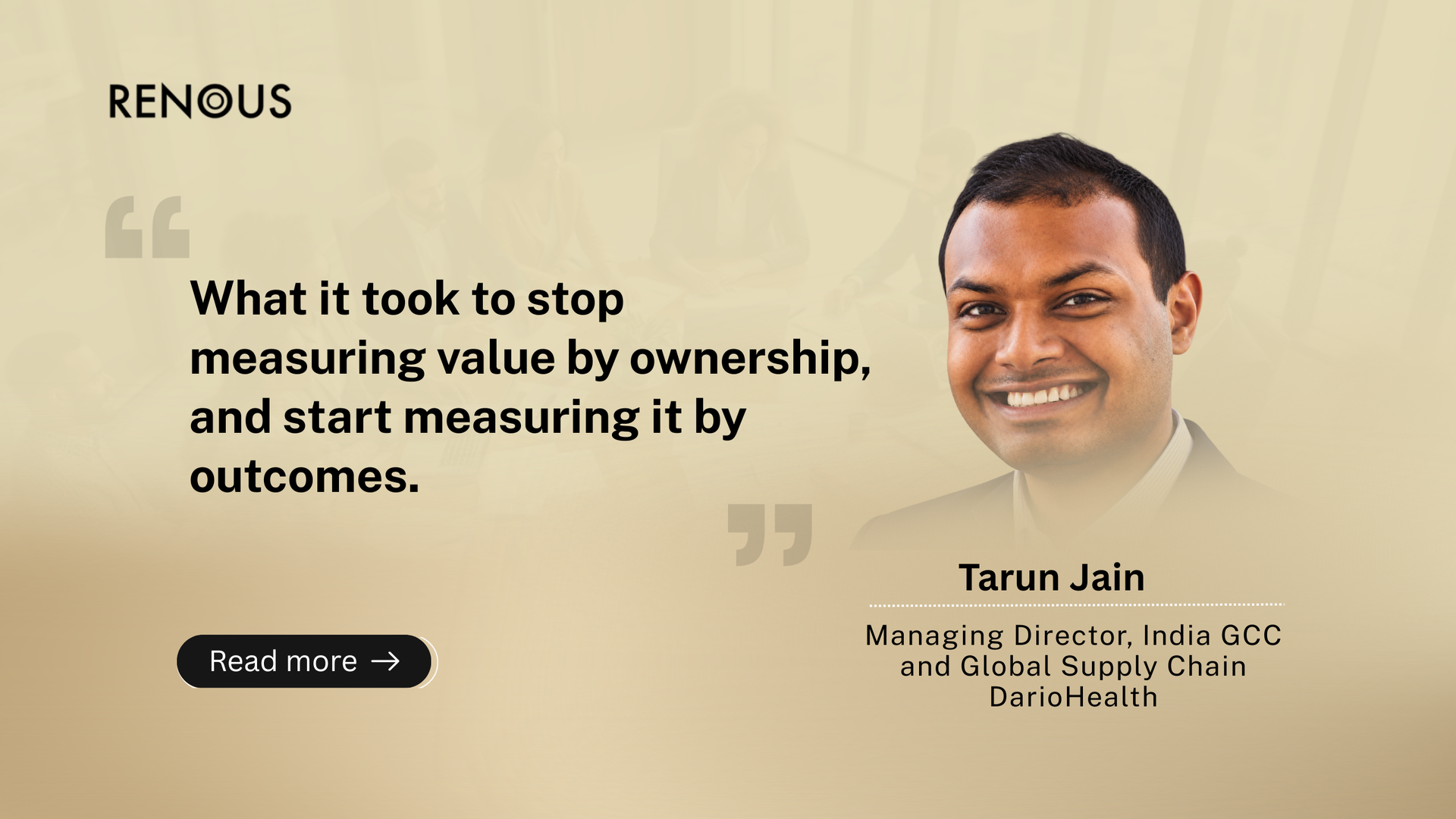
Leading a global capability center taught me that value is not defined by proximity to headquarters.
And global supply-chain responsibility has reinforced that leadership is ultimately measured by outcomes.
The Journey Continues
The journey is still long, but it remains meaningful. I continue to work at the leading edge of digital therapeutics, in a space that first captured my imagination at Mayo Clinic. The titles and mandates may change, but the underlying motivation has stayed consistent:
“Build solutions that matter. Create value across boundaries. Keep learning through every pivot.”
The hardest transitions are not always the ones that change your location or job title. “They are the ones that require you to change your definition of value — and to rebuild your confidence around a new way of contributing.”
That is what the pivot has meant for me.