 Vantage
The AI Cost Paradox
I have been thinking about this for some time.
There seems to be a bit of a pause in enterprise GenAI adoption right now. Not a loss of interest. If anything, the interest is probably higher than ever.
But moving from pilots and experiments to full-scale deployment is proving to be a different conversation.
And increasingly, that conversation is about cost.
Enterprises are trying to understand what AI is actually going to cost when it moves from a few thousand users experimenting with a model to millions of transactions, thousands of agents and potentially billions of tokens.
The question is fairly straightforward:
Is the cost of the AI actually going to be lower than the cost of the people doing the work today?
It sounds like a simple calculation, but it isn't.
The cost of an AI solution isn't just the price of the tokens. There is inference, infrastructure, orchestration, RAG, data, integration, security, governance, monitoring and all the other things that are needed to make AI work reliably in an enterprise environment.
So I can understand why some organizations are taking a step back and doing the math before making the next big commitment.
But there is something else that I think we may be underestimating.
Jevons Paradox.
Back in the 19th century, William Stanley Jevons made an interesting observation about coal. Improvements in the efficiency of using coal did not necessarily result in less coal being consumed. In fact, because coal-powered machinery became more economical to use, its use increased.
Essentially, when something becomes cheaper, we tend to use more of it.
I think this could be particularly relevant to AI.
Today, we are asking whether an AI agent can perform a particular task more cheaply than a human.
But suppose the cost of AI comes down dramatically over the next few years.
If AI becomes cheap enough, we will start applying it to work that we don't automate today because it isn't economically worthwhile.
We will give every employee AI assistance.
Then we'll give processes AI agents.
Then we'll have agents interacting with other agents.
And eventually, we may redesign entire processes around the assumption that intelligence is cheap and available 24x7.
At that point, the amount of AI being consumed could increase far faster than the cost per token is falling.
So the paradox could be that cheaper AI doesn't necessarily mean lower AI spending. It could mean much greater AI consumption.
We have seen something similar with cloud.
As compute became cheaper and more accessible, organizations didn't just run their existing workloads at a lower cost. They created entirely new workloads because the economics allowed them to.
I suspect AI will go through something similar.
The Foundation-Model Market
There is another trend I find interesting.
I expect the foundation-model market to consolidate significantly.
We currently have a fairly large number of companies competing at the model layer. But training frontier models requires enormous amounts of compute, capital, data and engineering talent. Inference at scale has its own economics.
Over time, I wouldn't be surprised if the foundation-model market settles around three or four dominant players, much like we eventually saw in cloud computing.
That doesn't mean there will only be three or four AI companies.
Quite the opposite.
I expect the application and agent ecosystem built on top of those models to become enormous.
The infrastructure layer could consolidate while the application layer explodes.
The Bigger Question for Enterprise AI
Which brings me back to the question enterprises are asking today.
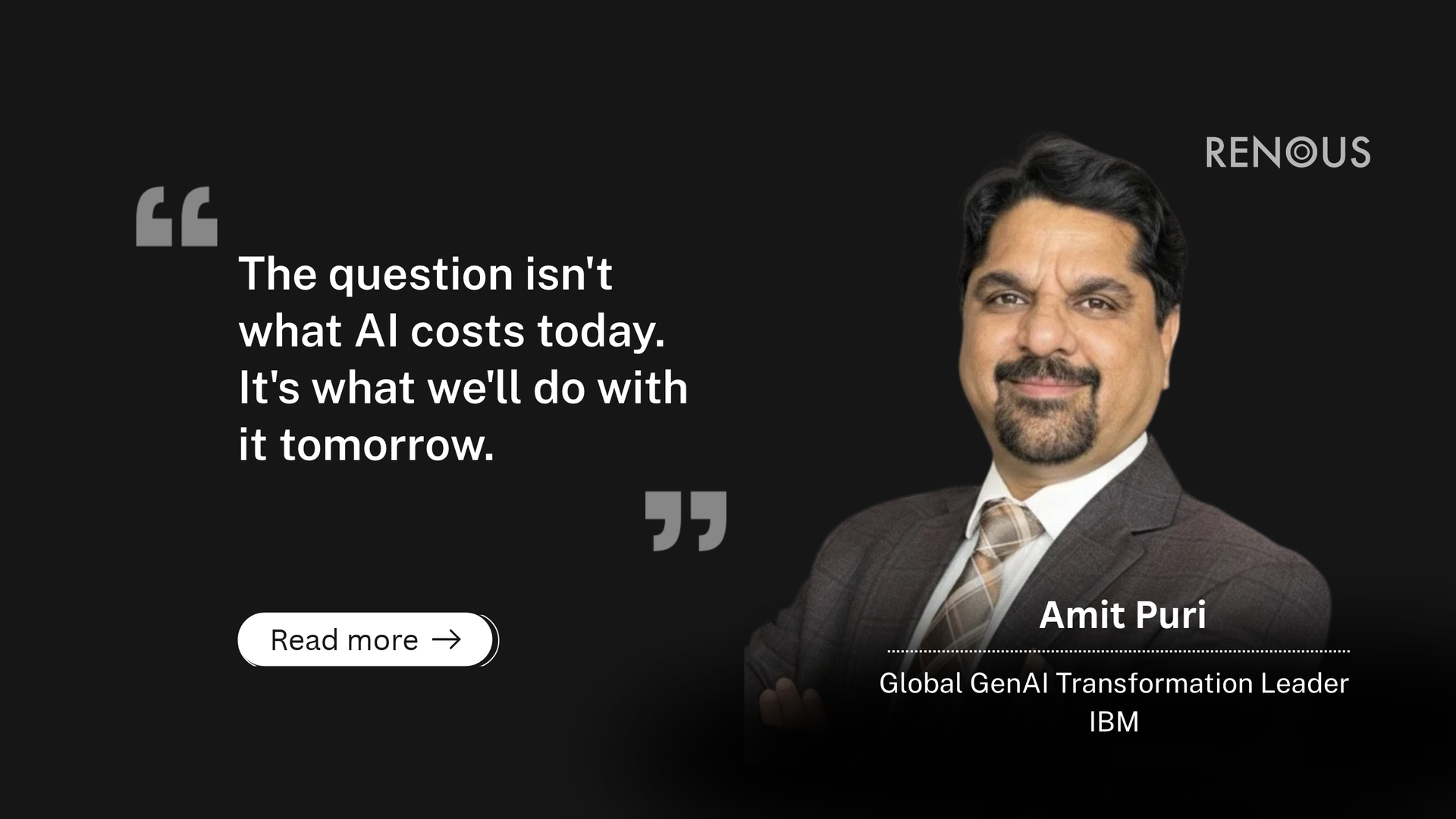
"What will AI cost us?"
I think that's the right question for now.
But it may not be the most important question for the next phase.
The more interesting question might be:
"What will we do with AI once it becomes cheap?"
Because if Jevons is right, the biggest impact of falling AI costs may not be that we replace the same amount of human work for less money.
It may be that we suddenly find a lot more work worth doing.
And that, in my view, is when the real enterprise AI transformation will begin.
Would be interested to hear how others are thinking about this, particularly those who are currently building the business case for large-scale GenAI adoption.