 Vantage

There is a quiet confusion spreading through boardrooms and founders' offices. It concerns me more than any market cycle.
“We have started to confuse using AI with building a business.”
I see it everywhere I work: on GCC stages, in rooms full of business owners, and inside the companies I sit with every week. Leaders are prompting, automating, summarizing and generating. Strategy papers that once took a quarter now take an afternoon. Yet when you look at the numbers that matter, such as revenue, margin, retention and win rate, surprisingly little has moved.
Two questions are worth answering privately.
First: how much time has your organization invested in AI over the past six months?
Second: what has measurably changed because of it?
If the second answer is vague, you are not alone. Activity has always been easy to mistake for progress. AI has made that mistake cheaper, faster and far more convincing.
Progress You Can Feel Versus Progress You Can Measure
There is a real difference between feeling that you are moving and actually moving. Today, AI is remarkably good at producing the first without the second.
Consider a few honest tests:
- AI now shapes your marketing. Has conversion improved?
- AI now supports your hiring. Is your team measurably stronger?
- AI now writes your competitive analysis. Are you winning more often in the market?
- Your workflows are now automated. Is margin improving, or only output?
These are not rhetorical questions. They are the only questions that matter. They are uncomfortable because the work itself is so satisfying. Stopping to measure feels almost unnecessary when the activity already feels like progress.
That is the trap. Most leaders who fall into it are not lazy. They are busy in precisely the wrong way.
Be Clear About What the Platforms Optimize For
This part of the AI conversation is rarely said out loud.
AI platforms are commercial products. Like every digital platform before them, they succeed when you use them more. Your profitability is not their metric; your engagement is.
The satisfaction you feel when a model hands you a beautifully structured framework in forty seconds is not an accident. It is the product working as designed.
None of this makes the technology less powerful. I use AI every day, and my team runs workflows that would have been impossible five years ago. But I try never to forget what it is: an extraordinarily capable tool, built to make you feel productive. Whether you actually are is a separate question, and only you can answer it.
The Revenue That Was Already in the Building
One of the clearest lessons I have had came from a steel trading business.
They were not short of ambition, ideas or tools. What they had, sitting quietly in their system, was 2,120 dormant leads. These were people who had once enquired and had simply never been followed up properly.
They did not need a new growth strategy. They needed structure, segmentation and disciplined, human follow-up with people who already knew them. Those leads were reactivated in 45 days.
I see versions of this constantly. In workshops with business owners, the turning point is rarely a clever prompt. It is the moment an owner stops generating plans and writes to a real customer, someone who has already trusted them once, and actually sends the message.
The lesson is simple.
“You are not selling to an algorithm. You are selling to people”
No model closes that distance. A genuine conversation often does.
AI Amplifies Whatever You Give It
The most useful mental model I know for AI is this:
“It is an amplifier.”
An extraordinary one, but still an amplifier.
A clean signal comes out clearer. A distorted one comes out as louder, faster and more expensive noise.
- If your offer is weak, AI helps you distribute a weak offer more efficiently.
- If your data is scattered, AI gives you confident conclusions built on unreliable inputs.
- If your thinking is unclear, AI produces clearer-sounding versions of that unclear thinking.
- If you are asking the wrong question, AI gives you a beautifully formatted answer to it.
The last point is the most dangerous, because polished output is harder to challenge. In twenty years of working inside the data of hundreds of companies, I have learned that the foundations come first: clean data, a clear understanding of how customers buy, and metrics that link activity to outcomes. AI belongs at the end of that sequence, multiplying what already works. It doesn't belong at the beginning, hiding what doesn't.
What a Prompt Cannot Give a Leader
Some capabilities separate leaders who build durable organizations from those who build impressive plans. None of them can be generated.
Reading the room. Earlier this year I moderated a panel of senior GCC leaders on whether organizations will hire people or deploy agents. My prepared questions were strong; AI could have helped me write a hundred more. What I judged most critically afterwards were my follow-up questions in the moment, when an answer needed pressing. That instinct comes only from repetition: sitting across from real people with real stakes and learning to notice what is not being said.
Judging people. Assessments and data help with hiring. The decision is still made in conversation, by someone who can tell conviction from performance. That judgment is earned through many conversations and more than a few mistakes.
The courage to disagree. AI systems are built to be helpful, balanced and agreeable. The conversations that have changed my thinking most were with people who looked at my plan and said plainly, "This is wrong, and here is why." No tool is designed to challenge you that way.
Knowing what not to do. The highest-leverage skill in leadership is choosing the one thing that matters now from the twenty things competing for attention. AI can widen your options. Only judgment can narrow them.
The Quiet Erosion of Independent Thinking
This is the trend that concerns me most.
Capable leaders are gradually outsourcing their judgment. This isn't happening in a dramatic way. It is happening in a practical, daily one. A strategic question that once took a week of reflection, conversations with advisors and a change of mind or two now gets an answer in under a minute.
The answer is usually articulate and well organized. But it isn't truly theirs. When a board member, a client or a regulator pushes back, there is no depth behind it to defend, adapt or improve in real time. They own a summary, not an understanding.
Information and understanding are different things. AI delivers information with remarkable efficiency. Understanding still comes the slow way: wrestling with a problem, being wrong, working out why, and building a position from the ground up.
“Independent thinking is a muscle.”
It weakens faster than most of us realize once we stop using it.
Never Easier to Start, Never Harder to Scale
A generation ago, the path was simpler, if not easy. Build a good product, serve customers well and let reputation do the rest.
Today a company can be registered, branded and advertising within a week. The barrier to entry has almost disappeared, which is exactly why scaling has never been harder. Every competitor has access to the same models. Customers are more informed, more skeptical and less patient. Platforms reward one approach this quarter and punish it the next.
AI didn't simplify that equation. It added another variable and handed everyone the same starting line. What happens after the start still depends on who is running.
Where AI Earns Its Place
Let me be clear: this is not an argument against AI.
My team uses it extensively, for research, drafting, analysis and automation. I use it myself every day to test ideas and refine my thinking. But one principle holds across every workflow we run:
“At the end of the chain, a human makes the call.”
AI surfaces options, drafts and analyses. A person with context, experience and accountability decides.
That decision point is where the value lies. A strong team using AI well is formidable. An average team using AI well is still an average team, only with more output. More of something mediocre is still mediocre; it just arrives faster.
Six Disciplines for Leaders
Not a framework. Six disciplines worth practicing.
1. Audit AI against outcomes, not activity. Look at the last 90 days. Where did AI contribute directly to a closed deal, a retained client, a shorter cycle or a better margin? If the answers aren't specific, the investment is going to the wrong place.
2. Name your one real constraint. Not ten priorities; one. It is rarely "we need a better AI strategy." It is usually something unglamorous: follow-up, conversion, retention or an unclear offer.
3. Talk to your customers. Call a handful of clients, not to sell but to understand what is hard for them now and what they wish you offered. A few honest conversations will teach you more than months of generated research.
4. Keep investing in human skills. Negotiation, leadership, reading people and deciding under uncertainty compound over decades. Many leaders stop investing in these as soon as they succeed. That is exactly when to double down.
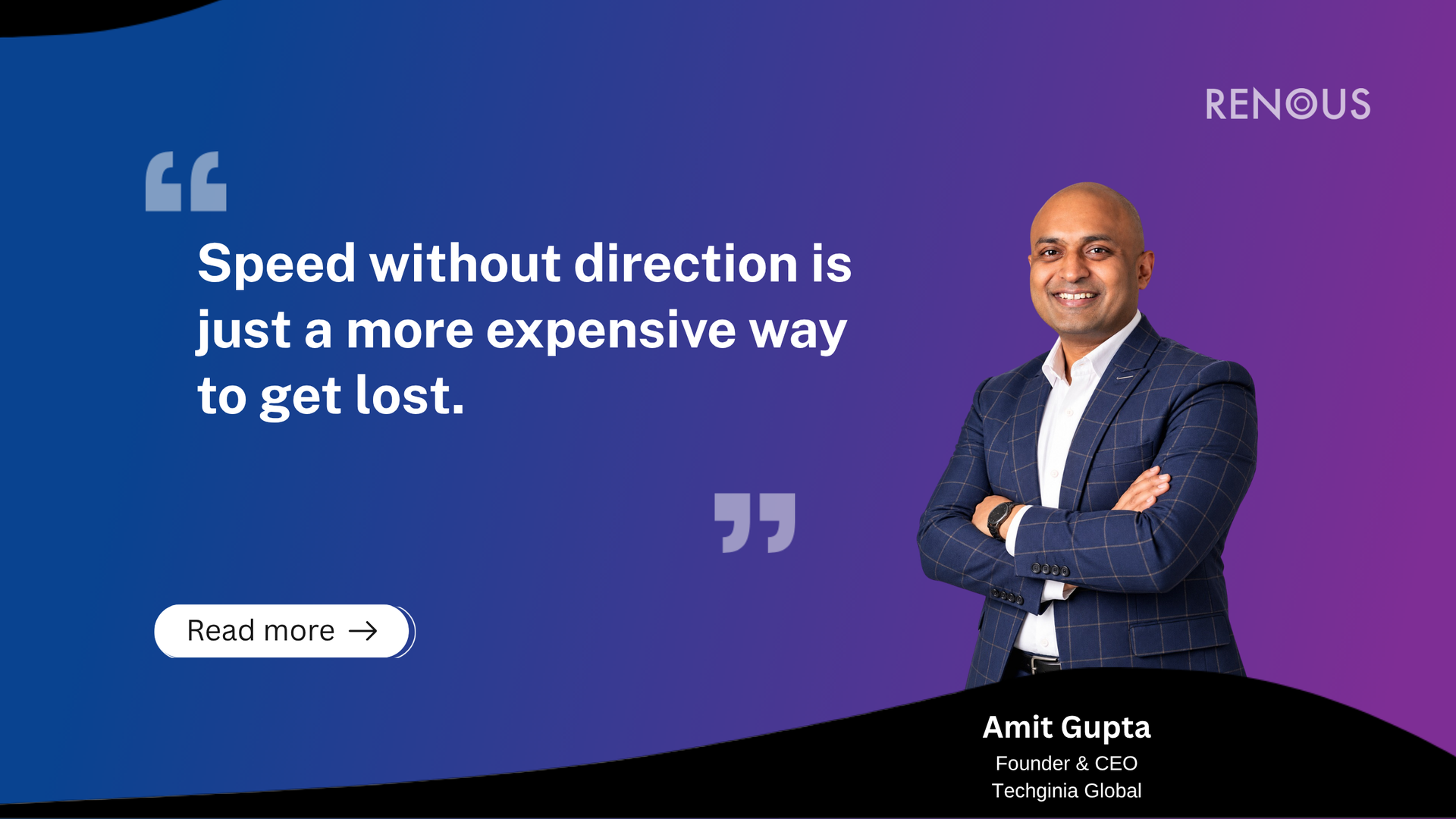
5. Build on strong fundamentals. Get the offer, positioning, data and sales motion right, then use AI to scale what already works. Speed without direction is just a more expensive way to get lost.
6. Think first, then consult the machine. Form your own view on important decisions before opening an AI tool. Then use AI to pressure-test it. That order is what keeps you the author of your own strategy.
The Tool Was Never the Advantage
Every generation of business leaders has faced its own version of this moment.
The companies that won with email were not the ones that sent the most email. The companies that won with social media were not the ones that posted the most. The organizations that win with AI will not be the ones that use it most.
They will be the ones that keep doing what has always mattered: building real skills, developing real judgment, creating real value for real people, and making hard decisions with incomplete information, then living with the consequences long enough to improve.
In capable hands, AI is a remarkable multiplier. Used to avoid the discomfort of building capability, it becomes an expensive way of standing still while feeling as though you are moving.
Your customers are not algorithms. They are people with pressures, budgets, bosses and families. That is still where the value is created.
Go and talk to them.