 Vantage
The HR fraternity in India rejoiced when Dr. Santrupt Misra was named CEO of Birla Carbon, and celebrated again at his elevation to CEO of the group's chemical business. A few years on, Chanel appointed Leena Nair as its Global CEO – a move that was no less than a fairy tale for HR professionals. In 2021, Amit Malik, the then Chief of People, Operations & Customer Service at Aviva India was elevated as its CEO & MD.
There may be some other examples of such moves, but all the 3 moves probably had a common thread. Leaders who built human-centred leadership that delivered real business impact moved to the top. Not only people impact but Business Impact through People.
“Not only people impact but Business Impact through People.”
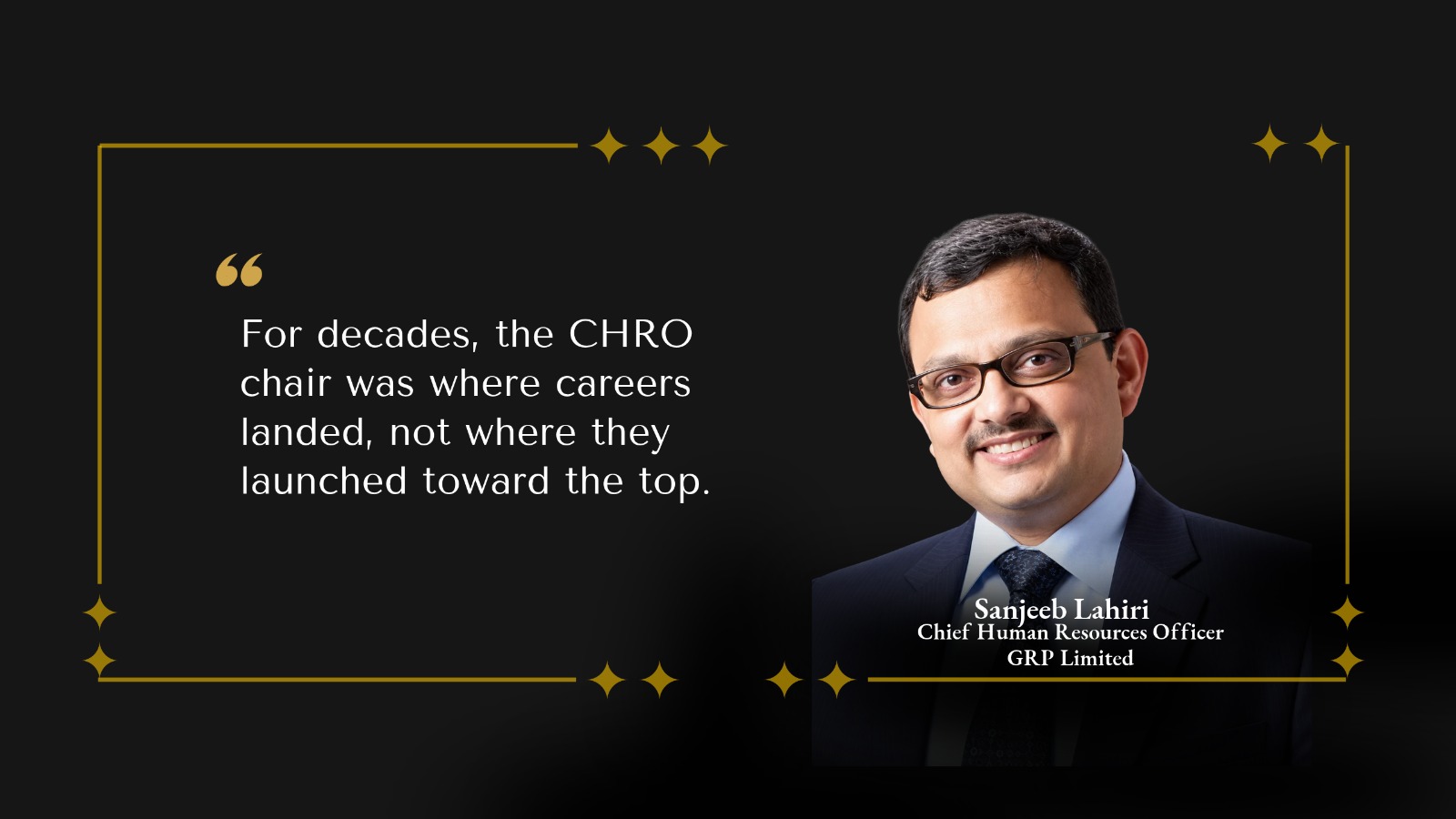
That distinction is the entire argument of this article. For decades, the CHRO chair was where careers landed, not where they launched toward the top. That is changing, and the change looks structural.
The evidence: the seat is real, and increasingly load-bearing
CHROs today attend most or every board meeting at a growing share of companies, and that engagement keeps rising — no longer a courtesy invitation. It matters most in the moment boards fear most: choosing the next CEO. Governance research increasingly finds boards leaning on CHROs to help design succession itself, at a moment when CEO turnover is running high and tends to pull CHRO turnover with it. Whoever owns the succession machinery isn't peripheral to strategy; they're building it in real time. The business case backs this up too: companies that make genuine progress on people issues are far more likely to hit the outcomes they set out to reach, and CEOs increasingly describe their CHRO as a genuinely effective partner.
Whoever owns the succession machinery isn't peripheral to strategy; they're building it in real time.
India isn't following this shift, it's leading it
The acceleration is sharper here than in the markets that usually set the benchmark. CHRO turnover among large Indian companies runs well ahead of the global average, and Indian CHROs are increasingly brought in with explicit transformation mandates, expected to prove strategic value early, as seen recently in several large Indian conglomerates. This is board language, not HR-department language, and it's now coming from HR leaders themselves.
This is board language, not HR-department language, and it's now coming from HR leaders themselves.
Earning the seat: it's built, not granted
No board or CEO hands over strategic trust because a title changed. Organizations that embed culture into day-to-day work see measurably better employee performance — a board-legible outcome that earns a CHRO real room in the strategy conversation. The CHROs who make this leap do it the same way: they stop reporting engagement scores and start reporting workforce risk, capability gaps, and succession readiness in the register the CFO uses for capital risk. AI has only sharpened this, pushing technology, skills shortages, and leadership development to the centre of the brief.
They stop reporting engagement scores and start reporting workforce risk, capability gaps, and succession readiness in the register the CFO uses for capital risk.
Holding it: trust, not tenure
Earning the seat once doesn't keep it. Influence tracks two things: the strength of the CHRO's partnership with the CEO, and the depth of genuine board engagement. It's lost when boards undervalue human capital expertise, when CEOs limit the CHRO's direct board access, or when a CHRO's commercial fluency doesn't hold up under scrutiny.
Many HR leaders assume success with the executive committee automatically transfers to the board. It doesn't. Executives focus on operations and execution; boards focus on long-term value creation, governance, risk, and succession, and want concise answers to a short list of hard questions, not a walkthrough of HR programmes: is succession robust, do capabilities support the strategy, can the organization execute transformation, is culture helping or hurting the plan. The same discipline applies to reporting: boards have little patience for activity updates, and want to know whether bench strength is real and performance is moving. CHROs who frame their time around outcomes become influential in governance conversations — and that trust compounds, rarely transferring cleanly to an external hire on day one.
Boards have little patience for activity updates, and want to know whether bench strength is real and performance is moving.
The remit is widening, and sustainability sits inside it, not beside it
This matters personally to how I define my own mandate. In India, ESG has moved from a CSR footnote to a board-level requirement, driven by mandatory sustainability disclosures and by investors and trade partners demanding credible standards before committing capital. A striking share of Indian professionals already work in roles tied to the energy transition or climate adaptation. Someone has to translate those commitments into an actual workforce: green skilling, safe and fair transition planning, the "S" in ESG that easily gets lost between the "E" and the "G." That work sits naturally with whoever already owns culture, capability, and workforce planning — which is why titles like Chief of People, Culture & Business Sustainability are appearing on organograms rather than staying separate lines. Treating sustainability as adjacent to the role means missing where the role should go.
Treating sustainability as adjacent to the role means missing where the role should go.
The CHRO as enterprise integrator
No other function touches every part of the enterprise the way HR does — finance, operations, technology, sales, legal, risk, procurement all run through people decisions somewhere. CHROs who use that vantage point deliberately, connecting strategy to execution and workforce capability to customer outcomes, stop operating as functional leaders and start operating as enterprise integrators. That's a different kind of authority than any org chart line confers.
CHROs who use that vantage point deliberately, connecting strategy to execution and workforce capability to customer outcomes, stop operating as functional leaders and start operating as enterprise integrators.
What it takes: five practical shifts
For any CXO, director, or founder building this function, or for CHROs building their own case for the table, the evidence points to the same five moves:
1. Speak business lingo.
Bring workforce risk, capability gaps, and succession readiness to the board the way the CFO brings capital risk, not as a compliance update.
2. Get ahead of the data.
Boards want forward-looking workforce projections with measurable milestones, not backward-looking metrics after the fact.
3. Build a direct board relationship.
CHROs whose access runs entirely through the CEO stay structurally limited, however strong that relationship is.
4. Prove value early, then keep proving it — influence here is renewed continuously, not granted once.
5. Own succession as shared governance.
The strongest outcomes come where the CHRO helps design the process, not just execute it once the board decides.
The chair is no longer a ceiling
Leena Nair has said she keeps a photo from her Unilever factory-floor days close by, a reminder of where the climb started. Indra Nooyi, made a similar climb to the top of PepsiCo decades earlier. Neither path ran through marketing or finance; both ran through people leadership, treated as business leadership from the start.
The broader picture backs this up: boards want CHROs in the room, CEOs increasingly come from the people function, and in India specifically, the shift is happening faster than almost anywhere else. For any leadership team still treating the CHRO seat as a support function with a chair at the table, the more accurate read is the opposite: it's increasingly where the next seat at the head of the table gets built.
It's increasingly where the next seat at the head of the table gets built.