 Vantage

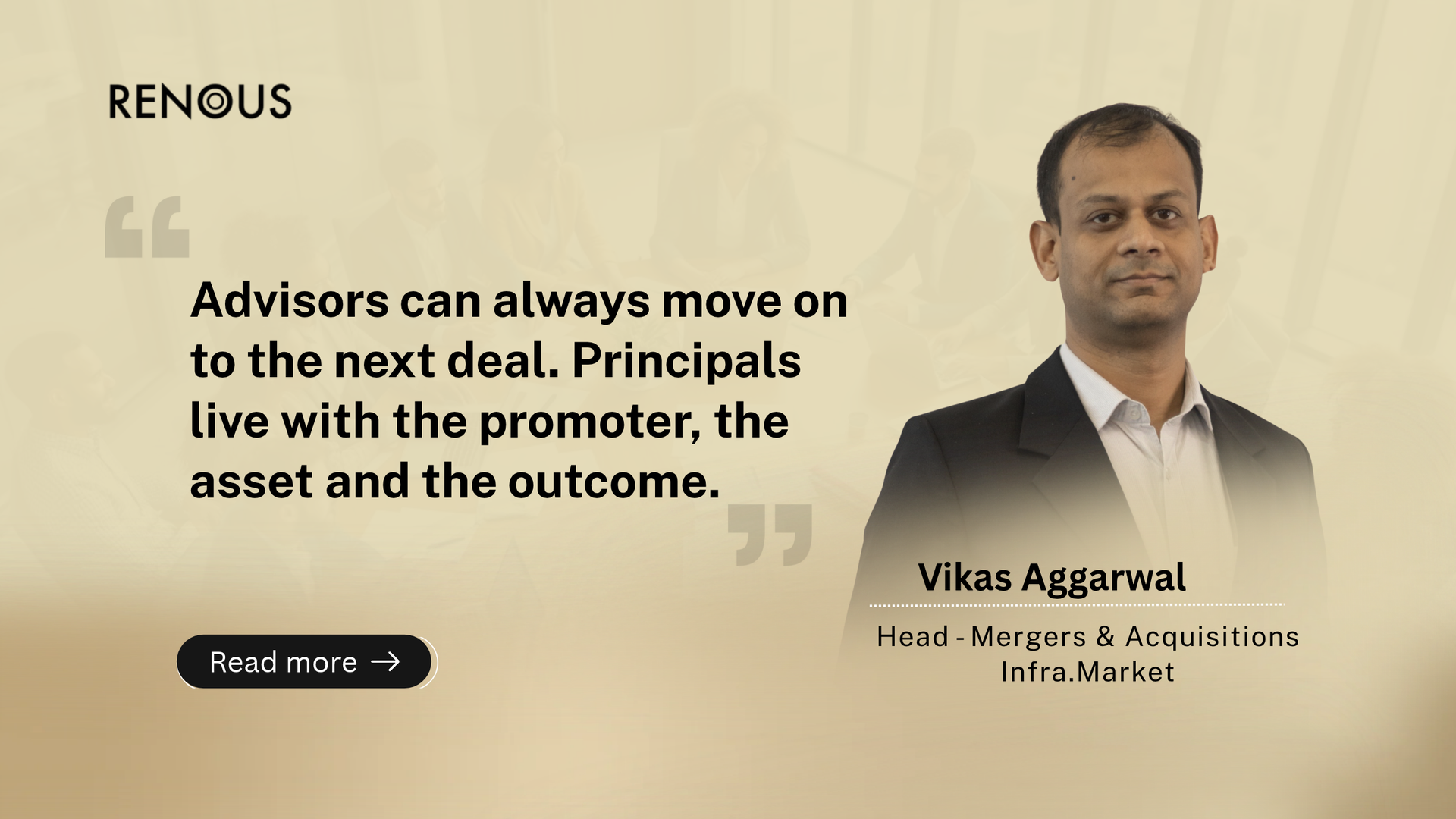
As an advisor, my job was to give clients my opinion on the choices. Here are the options, here’s what each one costs. The client picked, and I moved on to the next piece of paper.
It took me a while to see how much of a luxury that was. I only saw it after I crossed to the other side of the table.
THE TREADMILL
Sell-side is a treadmill, and I say that with affection. You come up with an idea, build the relationship, pitch for the mandate, put the materials together, find the buyer, get through diligence and documentation, close, collect your fee, and start again. It teaches you to run your own P&L. It teaches you patience, and it teaches you to keep going. It also gives you great insights, because every few months, you’re learning a new sector or segment.
And there’s one thing it quietly gives you.
“If a client is difficult or a deal has worn you out, there’s always a next one. You can move on.”
A CALL NOBODY COULD VERIFY
Some calls in this seat can’t be verified. A counterparty gives you their version of events, there’s no paper to back it up, and you decide whether to believe it. Sometimes it holds. Sometimes it doesn’t, and you find out late, when finding out costs more.
As an advisor, I’d have laid out both possibilities and let the client choose. As a principal, there was nobody to hand it to. I had to make the call, then work out how to limit the damage if I’d got it wrong.
Protections like an indemnity matter.
“A legal remedy and a working relationship are different things, and you can win the first and lose part of the second.”
WHERE THE FINISH LINE MOVED
As an advisor, I put my energy into the negotiation and into getting the client over the line. Closing was the whole point.
As a principal, closing is where the work starts. You’ll be living with the promoter and the asset afterwards, so the question stops being “how do I win this negotiation?” and becomes “what are we going to do with this business once the papers are signed?” The negotiation still matters. But most of my thinking now goes to what comes after.
It changes what you’re paid to care about, too. An advisor’s fee is tied to the transaction, so the pull is always toward closing. A principal doesn’t have that pull. You just have the outcome.
“As a principal, closing is where the work starts.”
THE STRETCH WHEN I DOUBTED THE MOVE
There was a period when I questioned whether I’d done the right thing. Months of effort on a deal can end at the last step, when the decision-maker decides it isn’t for him. On the sell-side, that’s a lost mandate and you walk away. Here, the decision-maker was my own client, and I couldn’t. What kept me going was my belief in the business model and my love for the sector.
“The role asks you to give it time.”
CHOOSING YOUR CLIENT
On the sell-side, your client is someone you can leave. On the principal side, your client is your promoter, and there are three things you can’t change: the sector, the company and the promoter.
So before you make the move, ask yourself honestly whether you can work with all three for years. There will be highs and lows, and you need a real conviction that the lows will pass. Without it, no title or package will get you through.
WHAT I’D TELL SOMEONE THINKING ABOUT IT
The grass always looks greener from the other side. From sell-side, the principal role looks like ownership and stability. From the principal seat, the advisor’s life looks like freedom.
I’d say start on the sell-side. That was my path, and I know others get there differently. But it shows you how a transaction works from every angle, so when you cross over you don’t take the other side’s job for granted. It makes you more agile, too.
“And when you do move, be ready to make the call yourself.”