 Vantage

For years, organizations have become increasingly sophisticated at measuring diversity.
We measure representation.
We measure hiring.
We measure gender ratios.
We measure leadership pipelines.
All of these tell us who is in the organization.
But they don't necessarily tell us what the organization is doing differently because those people are there.
And perhaps that is the next evolution of the diversity conversation.
“Diversity is not valuable simply because it changes who is in the room. It becomes valuable when it changes what happens in the room.”
That distinction is important for anyone thinking seriously about diversity as a business strategy rather than a compliance obligation.
Because the business case for diversity has never really been about representation alone.
It is about better access to talent, broader customer understanding, stronger challenge to assumptions, better decisions, innovation and organizational resilience.
The question is whether organizations have built the conditions for those benefits to actually materialize.
Representation Is the Beginning, Not the Outcome
There is compelling evidence linking leadership diversity with stronger business performance.
McKinsey's 2023 Diversity Matters Even More research found that companies in the top quartile for executive-team gender diversity were more likely to outperform financially than those in the bottom quartile. The same pattern was observed for ethnic diversity.
BCG's research similarly found that companies with above-average management-team diversity generated a higher share of their revenue from new products and services than companies with below-average diversity.
These studies establish correlation, not causation. Diversity alone does not make a company more profitable.
And that caveat is important.
Because it points us towards the more interesting question:
What is it about diverse organizations that can create better outcomes?
The answer isn't simply who is present.
It is what becomes possible when different perspectives genuinely influence decisions.
The Difference Between Diversity and the Value of Diversity
Imagine a leadership team with people from different genders, cultures, generations, professional backgrounds and life experiences.
Now imagine that every important decision is still shaped by the same voices.
- The most senior person speaks first.
- Everyone else aligns.
- The uncomfortable perspective remains unspoken.
- Consensus is mistaken for alignment.
The organization may have improved its representation.
But it hasn't necessarily improved its decision-making.
This is where inclusion becomes strategically important.
Diversity gives you difference. Inclusion determines whether that difference has influence.
And that influence is where the potential business value sits.
A diverse leadership team that makes decisions exactly as it did before has changed its composition.
A diverse leadership team that challenges an assumption about a customer, identifies a market opportunity others missed, questions a product decision, surfaces a previously invisible risk or approaches a talent problem differently has changed its organizational capability.
That is a much more meaningful measure of progress.
Organizations Need Different Perspectives
This is where the conversation becomes harder.
We want people who challenge conventional thinking—but what we often reward is constructive agreement.
We want people to bring different perspectives—but not make the decision uncomfortable.
We want diverse talent—but often expect them to adapt quickly to the dominant culture.
We want people to speak up—but the most senior voice still carries disproportionate weight.
We want innovation—but don't always create enough room for disagreement.
And so we create an interesting paradox:
“We hire for difference and manage for conformity”.
If that remains true, diversity becomes largely cosmetic.
The issue isn't whether people have different perspectives.
It is whether the organization has the leadership maturity, psychological safety and decision mechanisms to use them.
From Diversity Metrics to Business Metrics
This is where I believe the role of the CHRO needs to evolve.
Instead of asking only:
“How diverse are we?”
we should increasingly ask:
“Where is diversity changing an outcome?”
For example:
- Has broader talent access helped us enter a new market?
- Has diverse customer representation changed a product or service?
- Has a different perspective helped us identify a risk earlier?
- Are diverse leaders progressing into roles where they influence strategic decisions?
These questions connect diversity to the things business leaders already care about:
Growth, innovation, customers, risk, productivity and talent.
That changes the conversation completely and diversity becomes something the organization uses to become better at business.
This Also Changes How We Think About Talent Acquisition
For TA, the implication is significant.
A diversity strategy cannot end with:
“How many diverse candidates did we hire?”
The more strategic question is:
“Are we accessing talent pools that give the business capabilities and perspectives it doesn't currently have?”
That requires TA to understand the business deeply enough to know where difference could create value.
Sometimes the answer may be gender diversity.
Sometimes it may be geography, industry background, cognitive diversity, career path, technical experience or proximity to a particular customer population.
The objective isn't to manufacture diversity for a dashboard.
It is to expand the organization's capability to see and solve problems.
And that requires hiring managers, business leaders and TA to jointly own the outcome.
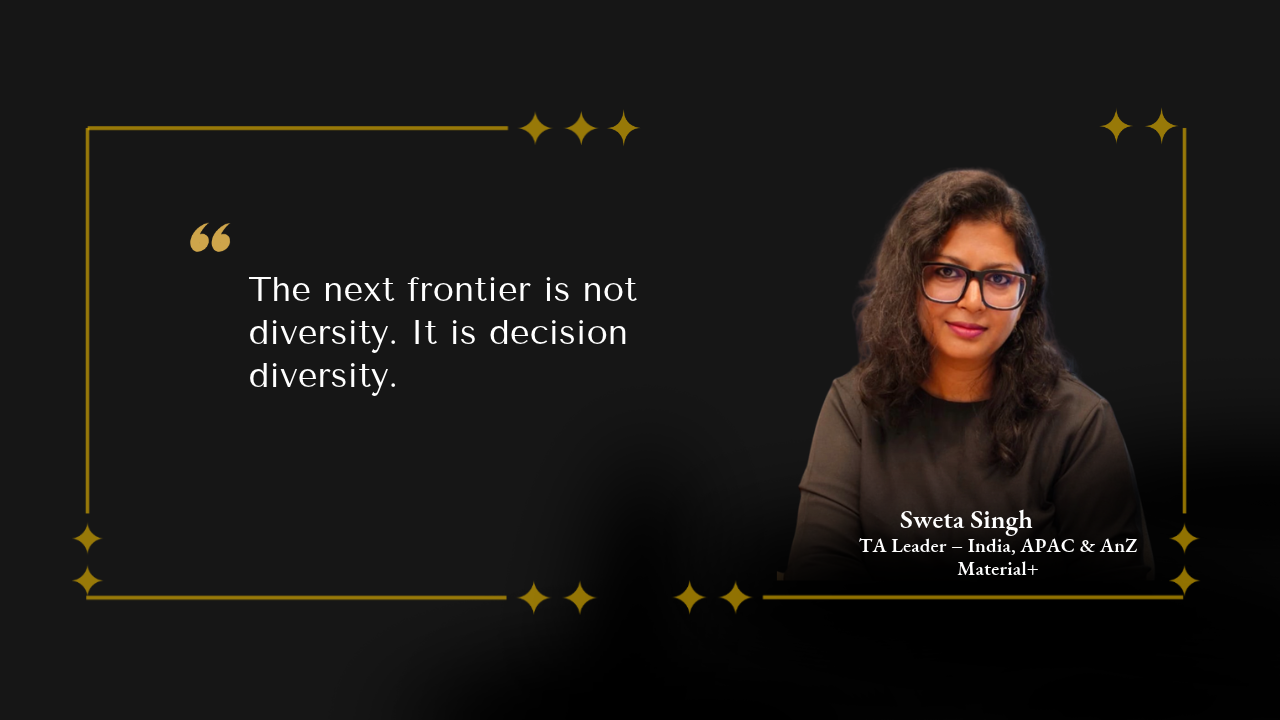
The Next Frontier Is Not Diversity. It Is Decision Diversity.
Perhaps this is where the conversation needs to go.
Not simply:
Who do we have?
But:
Whose perspective influences the decision?
Not simply:
How representative is our leadership team?
But:
Does the leadership team see something differently because of who is at the table?
Not simply:
Did we improve representation?
But:
What business outcome improved because we did?
That is a much harder standard. But it is also a much more meaningful one.
Because the ultimate value of diversity isn't that an organization can point to a more representative workforce.
It is that the organization becomes better at seeing what it previously couldn't see, questioning what it previously accepted, understanding customers it previously misunderstood and making decisions it might otherwise have missed.
Diversity is the input.
Inclusion is the mechanism.
Better decisions are the bridge.
Business outcomes are the proof.
And perhaps that is the shift organizations need to make now:
Stop asking whether diversity is good for business.
Start asking:
“Where, exactly, is the difference in our people making a difference to our business?”
That is when diversity stops answering to compliance—
and starts answering to business.