 Vantage

The role of the CHRO has undergone a profound transformation over the last decade. Not long ago, HR was often brought into discussions after strategic decisions had already been made. The business defined the direction, and HR was expected to execute by hiring talent, managing change, and ensuring compliance.
That approach is increasingly outdated.
Today, every major business decision has a people implication. Whether an organization is expanding into new markets, scaling a GCC, adopting AI, navigating economic uncertainty, or driving digital transformation, success depends on having the right talent, capabilities, leadership, and culture in place. As a result, the CHRO is no longer just an executor of strategy but a contributor to shaping it.
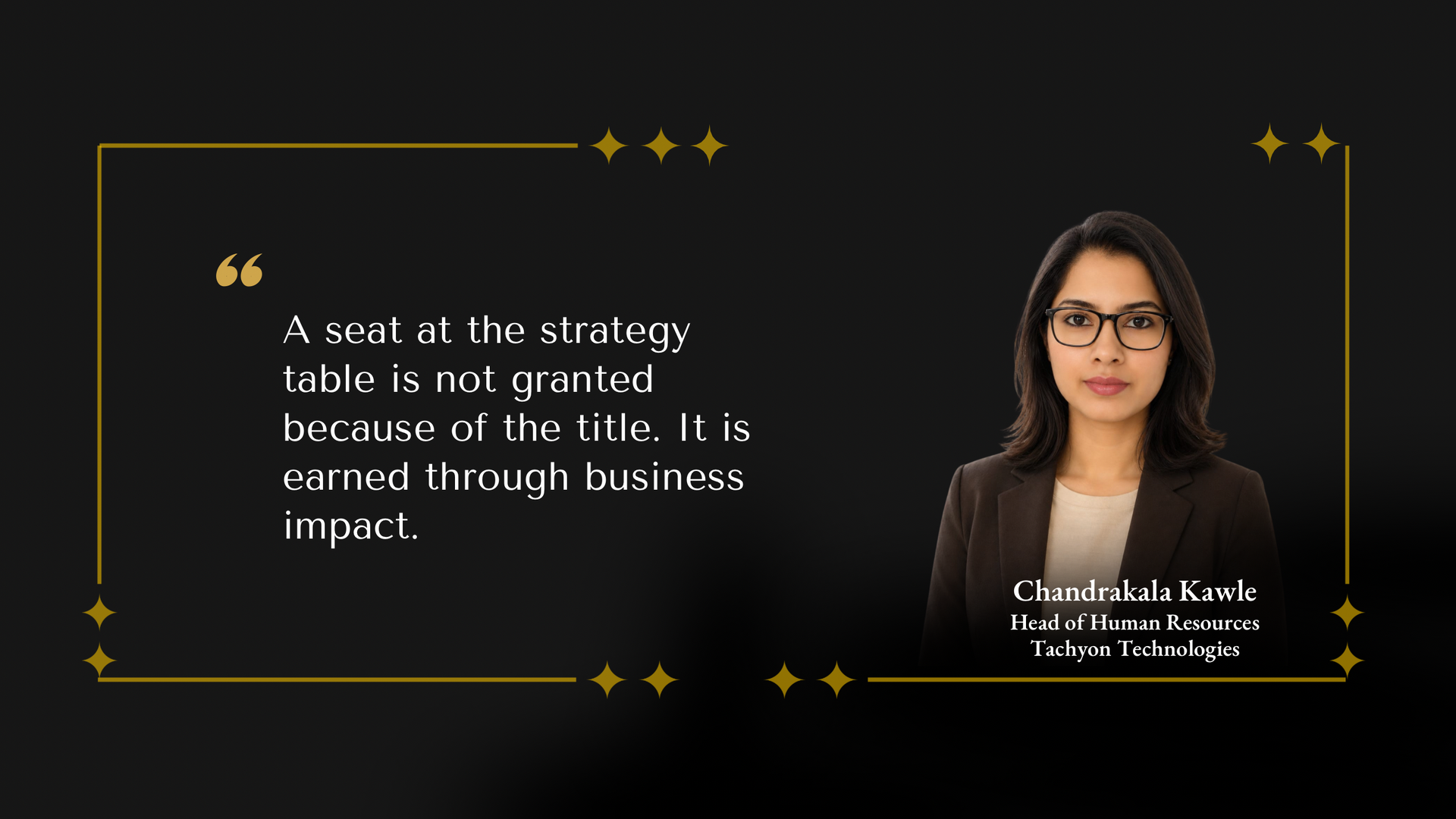
Yet, a seat at the strategy table is not granted because of the title. It is earned through business impact.
Business First, HR Second
One of the most important lessons I have learned throughout my career in technology, consulting, and HR analytics is that influence comes from understanding the business before understanding HR.
CEOs and boards are focused on growth, profitability, capability, productivity, innovation, customer outcomes, and risk. If HR leaders want to shape strategic decisions, they must be able to connect talent decisions directly to these outcomes.
For example, a discussion about hiring is rarely about recruitment. It is about revenue enablement, delivery capability, speed to market, or customer success. A conversation about leadership development is often a conversation about reducing execution risk. Workforce planning is ultimately business planning.
The CHRO who can quantify how talent impacts business performance quickly moves from being viewed as a support function leader to being recognized as a strategic partner.
In my experience, the most effective HR leaders spend as much time understanding business operations, client expectations, productivity metrics, and financial goals as they do employee engagement or HR processes. The moment a CHRO can connect workforce decisions to business outcomes, the conversation changes.
The function evolves from "people support" to "business leadership."
The New Boardroom Conversation
The rise of AI has accelerated this shift dramatically.
In technology organizations, we are witnessing something significant. Workforce strategy and business strategy are becoming increasingly inseparable.
Every executive team is asking the same questions:
- Which roles will AI augment?
- Which skills will remain relevant? Which skills will become obsolete?
- Which roles will be transformed by automation?
- How quickly can employees adapt to AI-enabled ways of working?
- What new capabilities will create competitive advantage?
These are not HR questions. They are business questions.
Yet the answers sit largely within the CHRO's domain.
Over the past few years, I have been actively involved in driving AI adoption initiatives, AI hackathons, workforce analytics programs, and capability-building efforts. One insight has become increasingly clear:
Organizations often invest heavily in technology but underestimate the human transformation required to realize its value.
Technology implementation takes months.
Behavior change takes years.
The competitive advantage of the future is unlikely to come from technology alone. It is more likely to come from how effectively organizations combine technology with human capability. The CHRO becomes critical because technology transformation succeeds only when people transformation succeeds.
Data Creates Credibility
Another significant shift is the growing importance of workforce analytics.
Historically, HR teams reported what had already happened. Attrition rates, hiring numbers, engagement scores, and training completion reports were useful but often descriptive rather than strategic.
Today's executive teams expect something different. They want predictive insights.
They want to understand where critical skill gaps exist, which teams may face retention risks, where leadership pipelines are weak, and what workforce challenges could affect future growth.
This is where HR analytics becomes a strategic differentiator.
Throughout my work in HR analytics, I have found that data creates credibility. It helps move discussions away from assumptions and toward evidence-based decisions. More importantly, it enables HR leaders to proactively identify risks and opportunities before they become business problems.
The CHRO who can use data to anticipate challenges earns a very different level of trust from business leaders compared to one who simply reports outcomes after the fact.
The CEO-CHRO Partnership Matters More Than Ever
A strong relationship between the CEO and CHRO is often one of the most underrated drivers of organizational success.
The best partnerships are not built on agreement; they are built on mutual trust and shared accountability for business outcomes.
The CEO focuses on enterprise performance, while the CHRO focuses on organizational capability. The intersection of those two perspectives is where sustainable growth happens. Together, they determine whether the organization has the leadership, culture, structure, and talent required to execute strategy successfully.
In many boardroom discussions, the CHRO plays a unique role. They often have visibility across functions, levels, and geographies that few others possess. This perspective allows them to identify unintended consequences, organizational risks, and cultural barriers that could undermine strategic initiatives.
A strategic CHRO is therefore not expected to merely support decisions. They are expected to challenge assumptions, provide alternative viewpoints, and help leaders think beyond immediate outcomes.
That requires courage, credibility, and a deep understanding of both people and business.
Organizational Power Comes From Solving Enterprise Problems
Many HR leaders ask how they can gain more influence. Yet influence does not come from being included in meetings. It comes from solving enterprise-wide problems.
The CHRO earns organizational power when they contribute to issues that extend beyond traditional HR boundaries:
- Building future-ready workforce capabilities for emerging technologies.
- Enabling successful digital transformation.
- Developing leadership pipelines.
- Improving productivity and organizational effectiveness.
- Supporting business expansion and growth.
- Managing change during periods of uncertainty.
- Navigating uncertainty
The more business challenges a CHRO helps solve, the more strategic their role becomes.
In high-performing organizations, the CHRO is not viewed as the head of a function. They are viewed as an enterprise leader whose decisions influence long-term business outcomes.
The Future CHRO
The modern CHRO sits at the intersection of business, talent, data, technology, and transformation.
As AI reshapes work and organizations face increasingly complex challenges, the ability to align people strategy with business strategy is likely to become a defining leadership capability.
The seat at the strategy table is no longer reserved for the person responsible for HR processes. It belongs to the leader who understands how workforce capability drives competitive advantage and who can help the organization prepare for the future.
The organizations that thrive in the coming decade are unlikely to have strong business strategies alone. They are likely to have CHROs who help shape them.
That is the evolution of the modern CHRO.