 Vantage
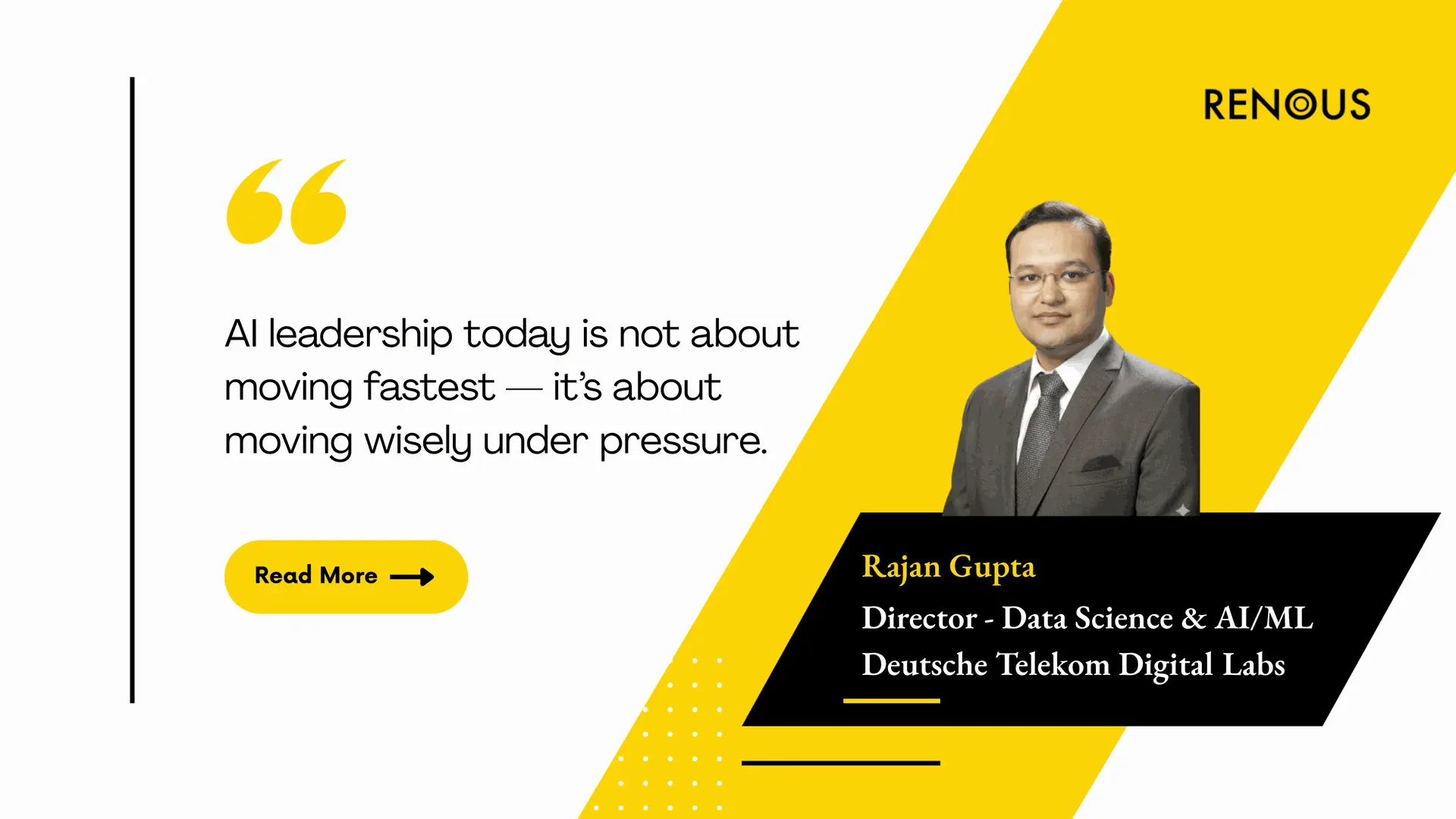
I have spent fifteen years building AI systems across global enterprises, and here is what many leaders quietly admit in private but rarely say in public: we are overwhelmed. Not because we do not understand technology, but because the volume, velocity, and volatility of change have become nearly impossible to process with calm, consistency, and confidence.
Every day brings a new model release, a new enterprise AI product, a new startup acquisition, a new benchmark, a new promise of transformation. By noon, someone from the board has forwarded a competitor announcement asking why we are not moving faster. By evening, another team wants approval to test the latest tool that was barely on the market last week. This is no longer just a technology adoption problem; it is an operating model problem. The unsaid truth is simple: leaders are not resisting innovation. They are trying to protect the business from mistaking motion for progress.
The Boardroom Paradox
Speed versus Safety
Today’s AI leader is expected to do two contradictory things at once: move fast and make no mistakes. Boards want urgency, visible implementation, and measurable returns. At the same time, they have little tolerance for failed pilots, data leaks, compliance issues, or inflated investments that do not convert into value.
That is the paradox few acknowledge openly. We are expected to absorb enormous amounts of change, trust systems that are still evolving, and make production-grade decisions before the technology itself has fully stabilized. If something works, the organization celebrates innovation. If it fails, accountability narrows very quickly. In that environment, caution is often misread as a lack of ambition, when in reality it is often the highest form of leadership discipline.
Governance Lag
Consider Samsung’s well-known 2023 incident, where employees uploaded confidential code and internal information into ChatGPT. The story was not really about careless employees alone. It was about governance arriving after experimentation had already started. Samsung responded with tighter controls, temporary restrictions, and a push toward internal alternatives. The deeper lesson for leaders is clear: enthusiasm for AI often enters the enterprise faster than policy, training, and data safeguards do.
That is where much of the private anxiety sits. Leaders know the market punishes hesitation, but it also punishes misjudgment. The board may remember who moved first, but the enterprise remembers who exposed risk without guardrails.
The Hidden Costs of Hype
Cognitive Overload
One of the least discussed realities of AI leadership is mental fatigue. A decade ago, major technology decisions involved long cycles of review, structured vendor comparison, and strategic debate. Today, many decisions feel like triage. Leaders are asked to assess tools, models, partnerships, acquisitions, and architecture bets at a pace that leaves very little room for thoughtful digestion.
This overload affects decision quality. When every update is positioned as a breakthrough, the line between meaningful innovation and amplified marketing starts to blur. Leaders begin to confuse activity with advancement. Teams spend more time evaluating possibilities than scaling what already works. The hidden cost is not only wasted time; it is erosion of judgment.
The Pilot Trap
That erosion often shows up in the form of endless pilots. Many organizations launch AI experiments not because the use case is clear, but because saying yes feels easier than defending no. Over time, this creates a silent tax on the enterprise: architecture reviews, legal reviews, security checks, integration work, change management, retraining, and reporting cycles for initiatives that may never create measurable value.
The Amazon Just Walk Out story offers a more nuanced example than the headlines suggested. When Amazon removed the technology from its Fresh stores in 2024, many rushed to label it an AI failure. But the better reading was different: customer behavior did not fully align with the original deployment model. Shoppers wanted more visible control and feedback during the buying journey. Amazon did not abandon the capability; it shifted toward a scaled B2B deployment in third-party venues. For executives, the lesson is not that the technology was weak. It is that even advanced AI must fit user behavior, business context, and operational reality.
Building Strategic Immunity
Filter Harder, Pilot Smaller
The leaders who endure are not the ones who chase every release. They are the ones who build systems for disciplined absorption. In practice, that means creating a structured filter between market noise and enterprise action. Not every announcement deserves a meeting. Not every demo deserves a pilot. Not every pilot deserves production.
Strong AI organizations now need a repeatable intake mechanism: a small sensing group to track developments, a clear threshold for business relevance, and a simple test for whether the opportunity solves a problem the organization genuinely has. Pilots should be smaller, faster, and tied to explicit outcomes. If the business metric is vague, the pilot should not begin.
Govern Earlier, Architect for Change
The smartest leaders are also changing where they place their energy. They are spending less time chasing the newest model and more time strengthening the foundations that make future adoption easier: data quality, model governance, architecture modularity, access control, and review discipline.
JPMorgan Chase offers a more constructive example of this approach. Rather than treating generative AI as a scattered collection of experiments, it built internal structures that allowed broader, safer adoption at scale. That is the real lesson for enterprises. Governance is not the brake that slows innovation; done well, it is the system that allows innovation to move faster with less friction. Leaders who build for modularity and trust are not falling behind. They are reducing the cost of every future decision.
Leading Through the Noise
The final challenge is not only technological; it is narrative. AI leaders must manage expectations upward as much as execution downward. Boards often operate with a fear of missing out, while delivery teams operate with a fear of breaking something important. Bridging that gap requires a more mature conversation about how enterprise adoption actually works.
That conversation starts with honesty. No leadership team can absorb every release, test every tool, or act on every market signal. Nor should it try. The better path is to create clarity: what we are monitoring, what we are piloting, what we are scaling, and what we are deliberately declining. In practice, the answer is simple even if execution is not: filter harder, pilot smaller, and govern earlier.
We cannot catch every wave, and we do not need to. The real job of leadership is not to chase every signal. It is to convert noise into judgment, pressure into discipline, and possibility into durable business value.
About Author
Dr. Rajan Gupta is an Enterprise AI and Data Technology leader with 15+ years of global experience driving AI strategy, analytics-led transformation, and technology implementation at scale. He is known for building high-impact AI products and scalable digital platforms powered by GenAI and Agentic AI tech stacks, enabling measurable business outcomes, stronger operational performance, and differentiated customer experiences.
Find him on LinkedIn: Rajan Gupta
Disclaimer from Renous
The opinions expressed in this article are those of the guest author and do not necessarily reflect the views of our publication. The information provided in this article is for general informational purposes only and should not be considered as professional advice. The reader should always conduct their own research and due diligence before taking any action based on the information provided in this article.