 Vantage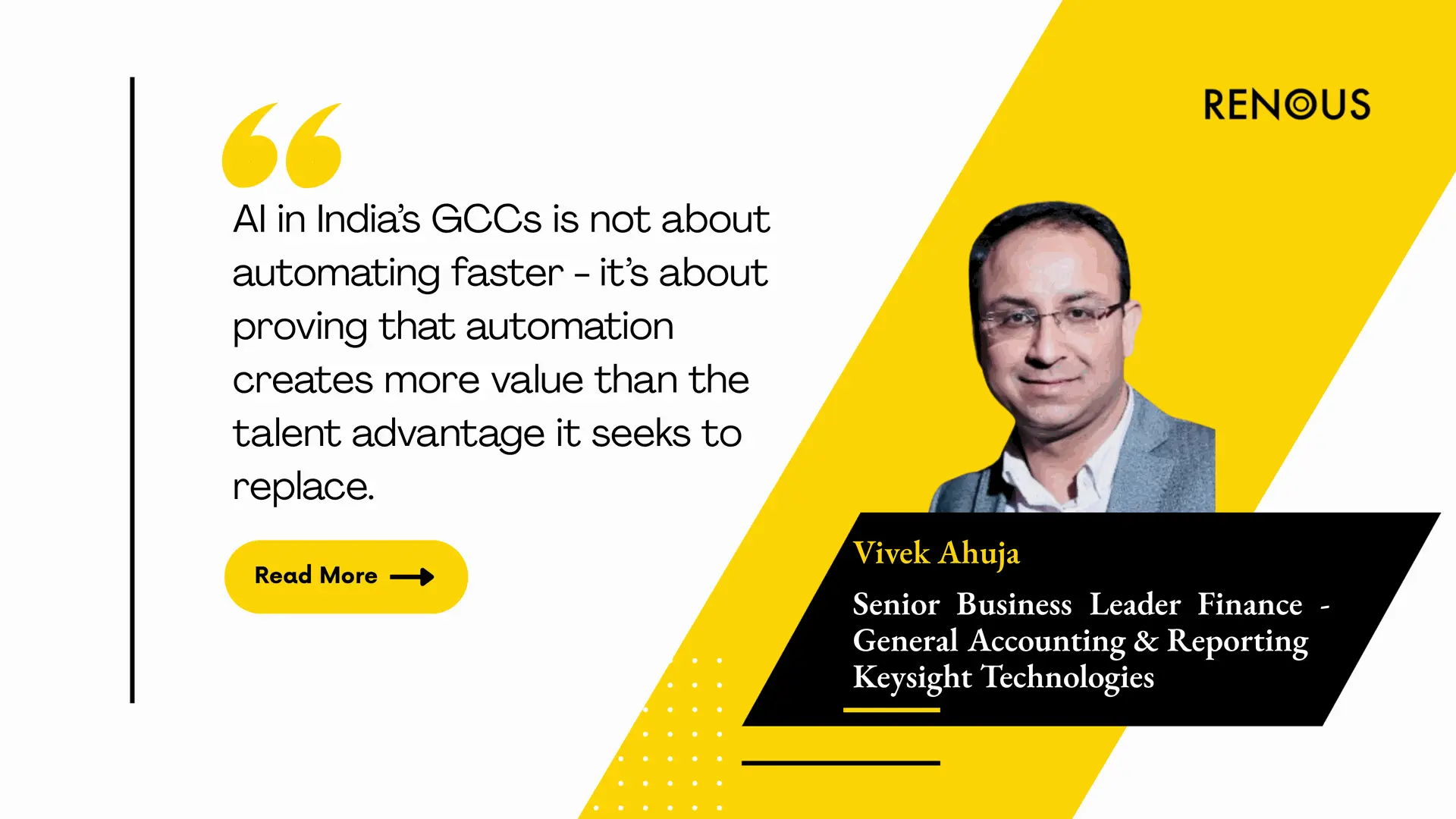
India’s GCC success story was built on one simple idea: cost arbitrage. Global companies moved work to India because they could access skilled talent at a fraction of Western costs. Over time, these centers evolved far beyond back-office support. Today, Indian GCCs run analytics, FP&A, digital transformation, procurement, technology operations, and even strategic decision making for global businesses.
Now comes the AI wave, and with it, an uncomfortable question many leaders discuss privately, but rarely say publicly.
Does large scale AI automation really make economic sense in low-cost markets like India?
In the US or Europe, the AI business case is relatively straightforward. Replacing expensive manual work with automation creates visible savings almost immediately. But in India, where operating costs are already optimized, the math becomes a little uncomfortable.
Take a typical finance or operations team sitting in a GCC. The process may already be running efficiently with skilled teams in Gurgaon, Bengaluru, or Hyderabad at significantly lower costs than equivalent teams overseas. What changes the economics is the substantial investment required for enterprise AI transformation program involving licenses, cloud infrastructure, consultants, governance controls, cybersecurity, and change management. In my experience working with GCC leaders, the productivity gains are real, but the financial returns rarely looks as clean as the original AI business case promised.
Publicly, almost every company wants to appear “AI-first.” Leadership teams are under pressure from boards, investors, and global headquarters to demonstrate AI adoption. But privately, many operational leaders are still trying to answer a more practical question: if a process is already running cost-effectively in India, how much additional value does automation truly create?
The reality is that most companies today are using AI more for augmentation than replacement.
Finance teams are using AI tools to generate commentary and summarize reports, but experienced professionals still validate the numbers and business context. Procurement teams may use AI to review contracts faster, yet commercial decisions continue to sit with humans. Customer service bots can handle routine queries, but escalations still land with support teams. Even in technology functions, AI helps improve developer productivity, but rarely removes the need for engineers altogether.
So while AI is definitely improving productivity, it is not eliminating jobs at the pace many headlines suggest, especially in India based GCCs.
This also creates a larger shift for the GCC model itself. For years, success was measured by scale: larger campuses, bigger teams, and continuous hiring. But AI may gradually change that equation. Future GCC growth may not come from adding thousands of people, but from creating more value with smaller, highly skilled teams.
And perhaps that is the real paradox of India’s AI moment.
Global companies moved work to India because human talent here was already the most efficient answer to the cost problem. Now, many of those same organizations are trying to automate that advantage away, only to discover that the economics are far less straightforward than the AI narrative suggests.
AI will undoubtedly reshape GCCs. However, the honest answer is that, nobody knows yet exactly how this recalibration plays out. But the GCCs that will come out ahead are likely the ones willing to ask the uncomfortable question first, rather than waiting for headquarters to ask it for them.
About Author
Vivek Ahuja a seasoned business and finance leader with 26+ years of experience across Ernst & Young and Agilent / Keysight Technologies, leading global finance transformation, GCC/shared services operations, and AI-driven process innovation.
Proven expertise in driving digital transformation, automation, risk management, and scalable finance operations while building high-performing global teams and fostering a culture of integrity, accountability, and continuous improvement.
Find him on LinkedIn: Vivek Ahuja
Disclaimer from Renous
The opinions expressed in this article are those of the guest author and do not necessarily reflect the views of our publication. The information provided in this article is for general informational purposes only and should not be considered as professional advice. The reader should always conduct their own research and due diligence before taking any action based on the information provided in this article.